Indian Food Products in High Demand Across Gulf Countries in 2026
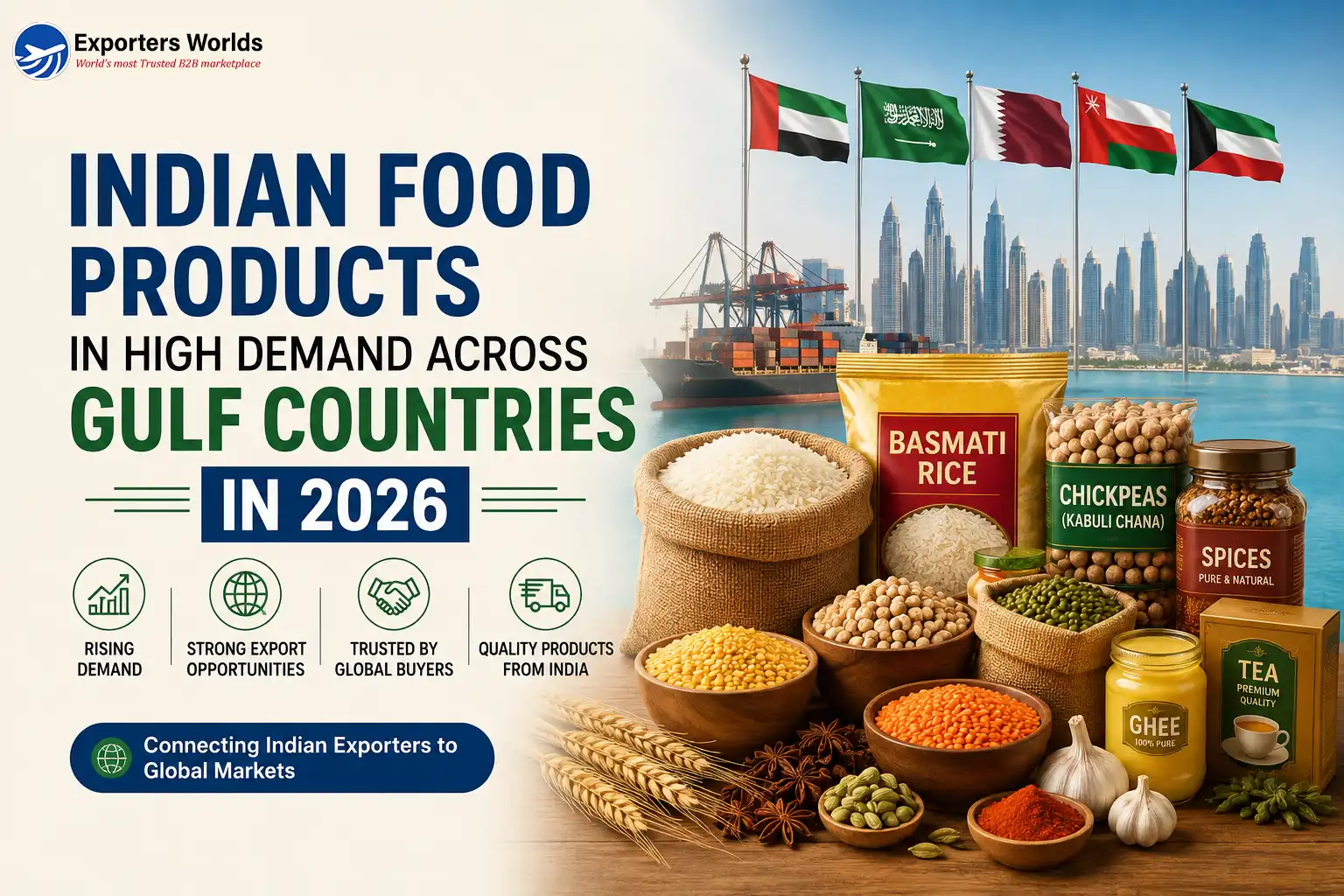
The Gulf remains an important export destination for Indian food businesses in 2026. Demand spans everyday staples, spices, fresh produce, packaged foods, beverages, and products supplied to supermarkets, restaurants, wholesalers, distributors, and food-service companies.
Among the Indian food categories with strong commercial relevance are rice, spices, pulses, fruits and vegetables, tea, coffee, processed foods, snacks, pickles, ready-to-eat products, seafood, and selected meat products.
However, choosing a product is only the starting point. Gulf buyers also consider quality, pricing, shelf life, packaging, food safety, documentation, halal requirements, delivery reliability, and the supplier's ability to maintain consistent supply.
Which Indian food products are in high demand in Gulf countries?
Rice, grains, and pulses
Indian rice has a strong presence in Gulf markets, particularly basmati rice, which serves households, restaurants, catering companies, retailers, and food-service businesses. Non-basmati rice and products such as lentils, pulses, flour, and other staples can also serve large-volume buyers.
For exporters, product quality and consistency matter as much as price. Buyers may evaluate grain specifications, packaging, shelf life, origin, quantity, and total landed cost before selecting a supplier.
Spices and spice blends
India's established spice industry creates opportunities for products such as turmeric, cumin, chili, coriander, black pepper, cardamom, and blended spices.
These products can be sold through retail and ethnic-food channels as well as restaurants, caterers, food manufacturers, wholesalers, and distributors. Bulk packaging and private-label supply can create additional B2B opportunities.
Compared with many fresh products, spices can also offer logistical advantages because of their longer shelf life and easier storage.
Fruits and vegetables
Fresh produce is another important category. Onions, potatoes, okra, green chilies, mangoes, grapes, pomegranates, and other fruits and vegetables can find buyers across Gulf markets.
The opportunity is closely tied to logistics. A successful vegetable export from India requires attention to grading, packing, temperature control, transit time, freshness, and spoilage reduction.
A product that looks profitable at the supplier's warehouse can become far less attractive after freight, handling, wastage, and other landed costs are included.
Processed and packaged Indian foods
Packaged Indian foods can help exporters reach consumers and businesses beyond commodity buyers. Relevant categories include pickles, papad, snacks, biscuits, sauces, ready-to-eat meals, frozen foods, and other convenience products.
These products may appeal to supermarkets, specialty retailers, distributors, restaurants, and private-label buyers.
Their advantage is differentiation, but exporters must pay close attention to ingredients, labeling, shelf life, packaging, food safety, and destination-specific registration requirements.
Why are Indian food products attractive in Gulf markets?
India and the Gulf have long-standing commercial and cultural connections. Indian cuisine is also familiar to consumers across the region, while substantial South Asian communities contribute to demand for familiar food products.
Still, buyers do not purchase simply because something is made in India.
Serious importers generally look for consistent quality, competitive landed pricing, reliable quantities, appropriate packaging, correct documentation, and responsive communication.
That makes supplier capability a major part of export success.
Which Gulf markets should Indian exporters target?
The Gulf Cooperation Council (GCC) consists of the United Arab Emirates, Saudi Arabia, Qatar, Kuwait, Oman, and Bahrain.
The UAE, particularly Dubai, is highly relevant to international food trade because it combines a sizeable consumer market with a major business, logistics, and distribution ecosystem.
Saudi Arabia offers another significant opportunity because of its large consumer base and extensive retail, restaurant, and food-service sectors.
Qatar, Kuwait, Oman, and Bahrain can also be relevant depending on the product and buyer segment.
There is no single "best" GCC market for every exporter. The better choice depends on product-market fit, regulations, freight economics, competition, and the type of buyer being targeted.
What should exporters know about halal food?
Halal food is an important consideration in Gulf markets, particularly for meat, poultry, animal-derived ingredients, and certain processed products.
However, exporters should not assume that every product has exactly the same halal certification requirements. Requirements may vary according to the product, ingredients, destination country, certification system, and importer expectations.
Food labeling, food safety, product registration, shelf-life rules, and other regulatory requirements are also important.
Exporters should verify the requirements applicable to their specific product and destination before accepting an international order.
What is involved in export to Dubai from India?
Businesses planning to export to Dubai from India need to think beyond finding a buyer.
Depending on the product, shipments can involve commercial invoices, packing lists, certificates of origin, health or sanitary certificates, customs documentation, and other product-specific requirements.
Import rules can also differ depending on whether the buyer is a distributor, retailer, restaurant group, wholesaler, or another commercial entity.
The safest approach is to establish the product specification, destination requirements, documentation, packaging, shipping terms, and importer responsibilities before dispatch.
Which agricultural products exported from India offer Gulf opportunities?
India exports a broad range of agricultural products, including rice, spices, pulses, fruits, vegetables, cereals, processed agricultural products, and other food commodities.
For Gulf-focused exporters, the strongest opportunity depends on the intersection of demand and practical supply capability.
Fresh produce can benefit from proximity and established trade routes, while spices, rice, pulses, and packaged products may offer advantages in storage and shelf life.
Rather than asking which product is universally "most profitable," exporters should assess:
demand + buyer requirements + supply consistency + compliance + logistics + landed cost + competition.
That calculation gives a much more realistic view of export potential.
Is water export from India to Dubai a good opportunity?
Water export from India to Dubai should be evaluated separately from conventional Indian food exports.
Packaged drinking water is heavy relative to its value, so freight, packaging, storage, distribution, and local competition can have a major impact on margins. UAE regulations and applicable standards must also be verified.
For many new exporters, higher-value or differentiated food products may offer a more practical starting point than shipping a low-value, high-weight commodity over a long distance.
What do Gulf importers expect from Indian suppliers?
A professional Gulf buyer may want to know:
- What is the minimum order quantity?
- What are the product specifications?
- What packaging formats are available?
- What is the shelf life?
- Which certifications are available?
- How much can the supplier consistently supply?
- What are the lead times and shipping terms?
- Can the supplier support private-label or bulk orders?
- Can the supplier provide complete documentation?
This is why exporters should prepare a strong company profile and product presentation before approaching international buyers.
Clear specifications, realistic capacity, packaging details, certifications, business credentials, and responsive communication can make a significant difference.
How can Indian exporters find serious Gulf buyers?
Visibility is useful, but relevant business connections are more valuable than simply generating large numbers of inquiries.
Platforms such as Exporters Worlds can help businesses present products, discover B2B opportunities, communicate with prospective buyers, and explore supplier-buyer connections. The platform also focuses on buyer qualification, marketplace visibility, and broader trade support.
For exporters, the objective should be to connect the right product with the right commercial requirement rather than simply chasing inquiry volume.
Final takeaway
The Gulf food market offers Indian businesses opportunities across rice, spices, pulses, fresh produce, processed foods, beverages, and other food categories in 2026.
But demand alone does not guarantee commercial success. Exporters must consider halal requirements where applicable, food safety, labeling, packaging, documentation, cold-chain needs, shipping costs, importer expectations, and supply consistency.
The strongest export opportunity is therefore not necessarily the product with the highest apparent demand. It is the product that an exporter can supply reliably, compliantly, and profitably to a clearly defined Gulf buyer.
FAQs
Which Indian food products are most in demand in Gulf countries?
Rice, spices, pulses, fresh fruits and vegetables, tea, coffee, processed foods, snacks, pickles, ready-to-eat foods, seafood, and selected meat products are important opportunity areas.
Which Indian products sell well in Dubai?
Rice, spices, fresh produce, packaged Indian foods, snacks, beverages, and other products serving retail, restaurant, wholesale, and distribution channels can be commercially relevant.
Is halal certification required for Indian food exports?
It depends on the product, ingredients, destination, and applicable regulations. Halal requirements are particularly important for many meat and animal-derived products and may also apply to certain processed foods.
Which vegetables are commonly exported from India to the UAE?
Products can include onions, potatoes, okra, green chilies, and other fresh vegetables. Commercial suitability depends on seasonality, quality, shelf life, packaging, and transportation.
What documents are needed to export food from India?
Requirements vary by product and destination but may include commercial, customs, origin, health or sanitary, and product-specific documents.
How can I find an Indian food exporter for bulk orders?
Define the product specification, required quantity, packaging, certifications, destination, and commercial terms first. Then evaluate suppliers based on capability, documentation, communication, and consistency of supply.
Which GCC country should Indian food exporters target first?
There is no universal answer. The UAE can be an attractive option because of its trade and distribution ecosystem, while Saudi Arabia offers a large consumer and food-service market. Product economics should guide the final choice.