Import Export Documents Checklist for Beginners: Complete India Guide for 2026
When you first enter international trade, finding a buyer or supplier seems like the hard part. Then the shipment gets close, and suddenly you are dealing with an IEC certificate, commercial invoice, packing list, shipping bill, bill of lading, certificate of origin, customs declarations and banking records.
For a first-time exporter, this can be overwhelming.
The key thing to understand is that import export documents are not isolated forms. Together, they create a connected record of the shipment for customs, DGFT, banks, freight forwarders, carriers, insurers and the overseas buyer.
The real goal is not simply collecting paperwork. It is making sure every document tells the same story.
India's merchandise and services exports were estimated at US$860.09 billion in FY 2025-26, up from US$825.26 billion in FY 2024-25. In April 2026, total exports were estimated at US$80.80 billion, while merchandise exports reached around US$43.56 billion. Electronic goods exports reportedly increased by about 40.31% year on year.
The opportunity is growing, but one missing approval or mismatched detail can still delay an expensive shipment.
What Are Import Export Documents and Why Are There So Many?
Trade documentation can be understood in five layers.
Business identity documents establish who is trading.
Commercial documents record what was agreed, in what quantity and at what price.
Customs documents explain what is entering or leaving the country.
Transport documents show how the goods are moving.
Compliance, banking and origin documents establish eligibility, payment legitimacy and product origin.
A beginner may prepare a perfect invoice but still face problems if the HS code is incorrect or a required product licence is missing.
For regulated products, that missing approval may matter more than the invoice itself.
Import Export Documents Checklist at a Glance
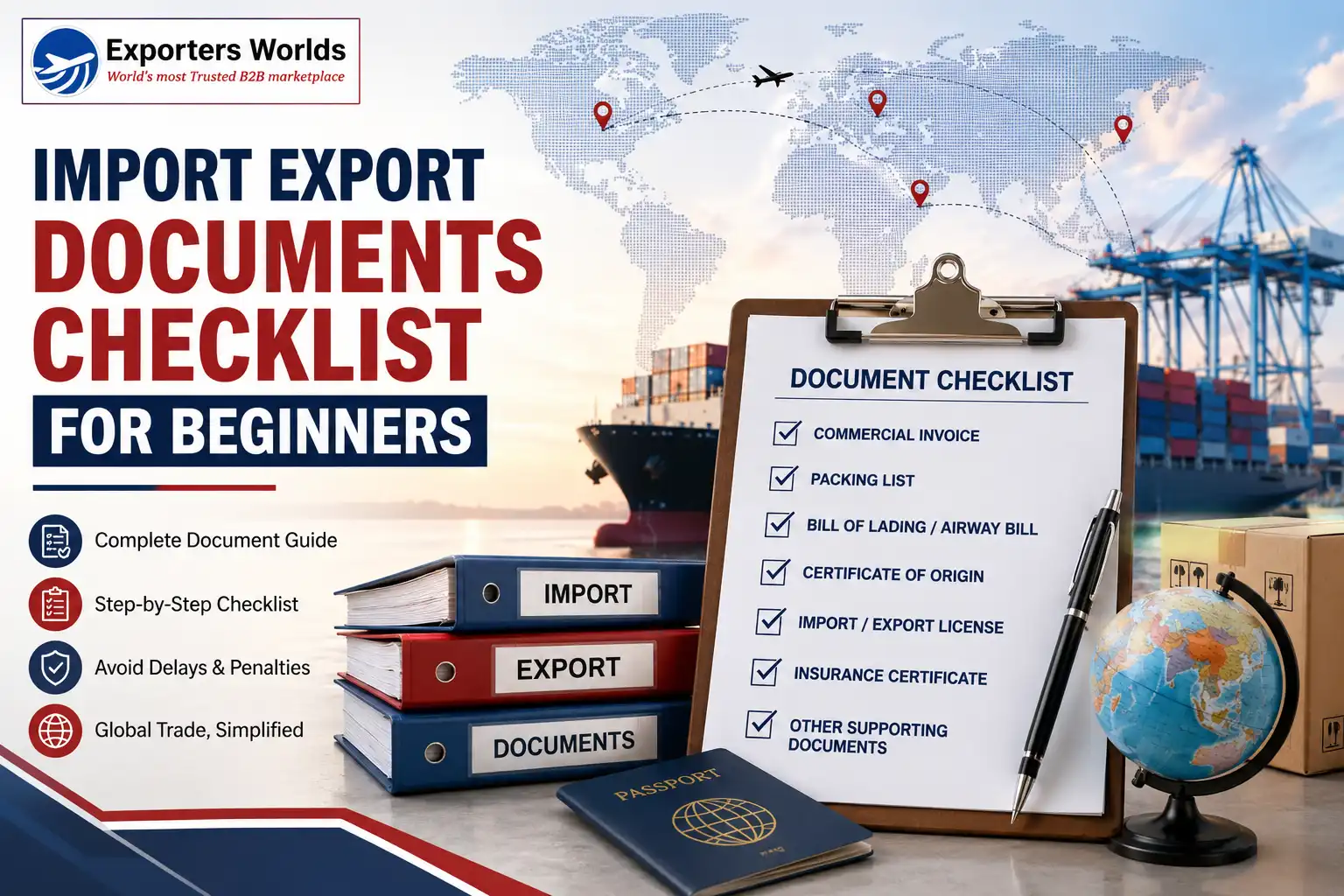
A practical import export documents checklist usually includes:
Foundational documents
- PAN and legal business registration
- IEC certificate
- GST registration where applicable
- Business current account
- AD Code arrangements
- ICEGATE access where applicable
- RCMC for relevant exporters
- Digital signature or e-authentication where required
Core export documents
- Export contract or purchase order
- Proforma invoice
- Commercial invoice
- Packing list
- Shipping bill
- Bill of lading or airway bill
- Certificate of origin
- Insurance certificate where applicable
- Inspection or product-specific certificates
- Export licence where required
- Banking and payment records
Core import documents
- Purchase order or import contract
- Commercial invoice
- Packing list
- Bill of lading or airway bill
- Bill of entry
- Certificate of origin where required
- Import licence and product approvals
- Insurance and customs-duty records
- Banking documents
These form the core documents required for import and export in India, although exact requirements depend on the product and destination.
IEC Certificate: The First Trade Identity to Understand
IEC stands for Importer Exporter Code and is issued through DGFT.
An IEC certificate links the business entity with its PAN and supports import-export activity across customs, DGFT and banking processes, subject to applicable exemptions.
Before applying, ensure the legal name, PAN, address, mobile number, email, bank information and authorised-signatory details are consistent.
A common beginner mistake is treating IEC as something to download once and forget. In reality, it should be treated as an active trade identity.
Commercial Invoice: The Document Everything Else Checks
The commercial invoice is one of the most important import export documents.
It usually includes seller and buyer details, invoice number, product description, ITC HS code, quantity, unit price, currency, Incoterm, origin, payment terms and shipment information.
Consistency matters more than fancy formatting.
If the invoice says "100% cotton men's shirts", the packing list says "garments", and the customs declaration uses another description, questions can arise even when the goods are perfectly legitimate.
Your invoice, packing list, customs declaration, transport document and certificate of origin should clearly describe the same transaction.
Packing List: Where Paperwork Meets the Physical Shipment
The packing list records how the shipment is physically packed.
Check:
- Carton, crate or pallet count
- Package numbering
- Item quantities
- Gross and net weight
- Dimensions
- Shipping marks
- Container details
Always compare invoice quantity against packing quantity, package count against carrier data, and shipment weight against the transport document.
A one-digit error may look small on a screen. It looks much bigger when customs or the buyer notices it.
Shipping Bill and Bill of Entry
The shipping bill is central to the Indian export documentation process.
It records exporter details, IEC, product classification, quantity, value, buyer, destination and relevant export declarations.
Before filing, carefully review the ITC HS code, value, quantity, destination, export-benefit claims and bank-linked details.
On the import side, the bill of entry serves as the main customs declaration. Customs evaluates importer details, supplier, classification, customs value, origin, duty and applicable regulatory requirements.
Incorrect classification, valuation or origin can lead to duty exposure and clearance delays.
Bill of Lading Explained Simply
A bill of lading is primarily used for sea freight.
It generally serves three functions:
- Evidence that the carrier received the goods
- Evidence of the contract of carriage
- In some forms, a document of title
Before final issuance, check the shipper, consignee, notify party, vessel, ports, container and seal numbers, package count, cargo description, weight and freight terms.
A straight B/L names a specific consignee. A negotiable B/L may support transfer of title. A sea waybill supports cargo release without operating like a negotiable title document. House and master B/Ls are typically issued by different parties in the freight chain.
For air cargo, an airway bill is used instead. An AWB generally does not function as a negotiable document of title in the same way.
Certificate of Origin: Small Document, Big Consequences
A certificate of origin confirms where goods originate.
Origin is not automatically the same as the country of shipment.
Goods manufactured in India but routed through another country may still have Indian origin if the applicable rules are satisfied.
A non-preferential certificate establishes origin. A preferential certificate may help an eligible product claim tariff benefits under a trade agreement.
Beginners should not treat preferential origin like an automatic discount. Eligibility depends on the trade agreement, product, rules of origin and supporting documentation.
The Export Documentation Process, Step by Step
A reliable export documentation process usually follows this sequence:
1. Establish the business
Align PAN, banking information, GST requirements, IEC and other relevant registrations.
2. Classify the product
Determine the correct ITC HS code before quoting or shipping.
Classification can affect licensing, policy status, certificates and export benefits.
3. Check regulatory status
Verify whether the goods are free, restricted, prohibited or subject to additional conditions.
4. Finalise commercial terms
Agree on specification, price, quantity, currency, Incoterms, payment, insurance and document requirements.
5. Prepare shipment documents
Issue the proforma invoice, final commercial invoice and packing list.
6. Arrange approvals
Depending on the product, this may include COO, inspection, fumigation, phytosanitary or quality documents.
7. File the shipping bill and arrange freight
Work with the freight forwarder, carrier and customs broker.
8. Complete customs clearance
Review the final B/L or AWB before accepting it.
9. Complete payment documentation
Retain banking records, LC documents, tax records and export-realisation evidence.
The Import Documentation Process
Import documentation follows a similar logic.
The importer should first establish the entity, obtain IEC where required, classify the product, check import-policy status, verify supplier credentials and confirm applicable certifications.
Before the shipment arrives, review the invoice, packing list, B/L or AWB, COO, insurance and licences.
Then file the bill of entry, pay customs duty, complete required examinations and secure cargo release.
One of the most expensive beginner mistakes is discovering after arrival that the product required a registration or licence.
Product-Specific Documents: Where the Standard Checklist Ends
The exact paperwork depends on the product.
Food and agricultural goods may require food-safety, laboratory, phytosanitary or fumigation documents.
Animal-origin products may need veterinary or sanitary certificates.
Pharmaceuticals, medical devices and cosmetics can require licences, registrations and quality evidence.
Electronics and machinery may involve conformity, testing or technical standards.
Chemicals and hazardous cargo may require SDS or MSDS documents and dangerous-goods compliance.
Exact documentation depends on the HS code, product, destination or source country and current regulation.
Make Every Document Tell the Same Story
This is the most useful rule in trade documentation.
Keep these data points consistent:
- Seller and buyer
- Product description
- HS classification
- Quantity
- Package count
- Weight
- Value
- Origin
- Ports
- Incoterms
- Invoice reference
Imagine the invoice shows 10,000 units, the packing list shows 9,800, and the B/L shows 10,000.
That mismatch can trigger customs clarification, banking discrepancies, buyer disputes or insurance problems.
Documentation control is mostly comparison work. That is exactly why it works.
Common Documentation Mistakes Beginners Make
The most frequent errors include vague product descriptions, wrong HS codes, incorrect weights, quantity mismatches, wrong origin declarations, misunderstood Incoterms, missing product approvals and LC discrepancies.
Another common mistake is assuming the customs broker is the final quality-control layer.
A broker can prepare and file documents, but the business should still review critical commercial information internally.
Import Export Documentation Trends in 2026
Trade documentation is becoming increasingly digital.
Electronic customs declarations, faster data transmission and system validation are improving efficiency, but they also reduce tolerance for inconsistent data.
Certificates of origin are moving deeper into digital workflows, while rules of origin are becoming more commercially important because they can directly affect landed cost.
Trade-data platforms are also making it easier to study products and target markets.
Most importantly, documentation quality is becoming a supply-chain performance factor. It affects delivery reliability, working capital, clearance speed, customer confidence and payment timelines.
How to Build a Simple Document-Control System
Create one master folder for each shipment and organise it into contracts, invoices, packing, customs, transport, origin, compliance, banking and post-shipment records.
Maintain a master sheet containing invoice number, HS code, quantity, value, consignee, origin and ports.
For high-risk fields such as HS classification, commercial value, origin, Incoterm and licence status, use a second-person review.
This is also the point where many small businesses realise that documentation is only one part of the problem. They may also need buyer verification, market access, export guidance and smoother deal coordination.
That is where Exporters Worlds becomes relevant. Instead of functioning only as a B2B marketplace, the platform supports businesses with buyer connections, export assistance, trade documentation, digital visibility and deal facilitation. For first-time exporters, having these functions connected can reduce the fragmentation that often makes international trade harder than it needs to be.
Beginner's Final Import Export Documents Checklist
Before shipment, verify:
Business setup: IEC, PAN, banking details, GST status and entity information.
Commercial documents: contract, purchase order, invoice and packing list.
Customs documents: shipping bill or bill of entry.
Transport documents: bill of lading or airway bill.
Origin and compliance: COO, licences, inspections and product approvals.
Banking records: LC documents, remittance records and payment evidence.
Post-shipment records: customs, tax, accounting and compliance files.
A complete file is useful. A consistent file is what makes it operationally reliable.
FAQs About Import Export Documents
Is an IEC certificate mandatory for every import or export?
IEC is generally required for commercial import and export of goods, subject to applicable exemptions and current DGFT rules.
What is the difference between a bill of lading and an airway bill?
A bill of lading is mainly used for sea freight. An airway bill is used for air cargo and generally does not function as a negotiable title document in the same way.
Is a certificate of origin mandatory for every shipment?
No. It depends on the destination, buyer requirements, product and whether preferential treatment is being claimed.
What is the difference between a shipping bill and a bill of entry?
A shipping bill is used for export customs declaration, while a bill of entry is used for import clearance.
Conclusion: Treat Documentation as Part of the Shipment
Successful trade documentation comes down to consistency.
Your IEC certificate establishes trade identity. The commercial invoice and packing list describe the transaction and physical goods. The shipping bill or bill of entry supports customs clearance. The bill of lading or airway bill documents transport. The certificate of origin establishes origin. The export documentation process connects all of them.
For a growing importer or exporter, managing this alongside buyer discovery, verification, negotiation and market expansion can quickly stretch internal resources.
Exporters Worlds is well positioned for businesses that want these needs handled more cohesively. By combining a B2B marketplace with export assistance, buyer verification, trade documentation support and digital promotion, it helps businesses move beyond simply finding an opportunity toward executing it properly.
Before committing cargo, build a shipment-specific checklist, verify the exact ITC HS code and country requirements, and review every high-risk field before filing.
In international trade, good opportunities matter. Good execution is what gets them across the border.