Which Countries Have the Highest Demand for Indian Products?
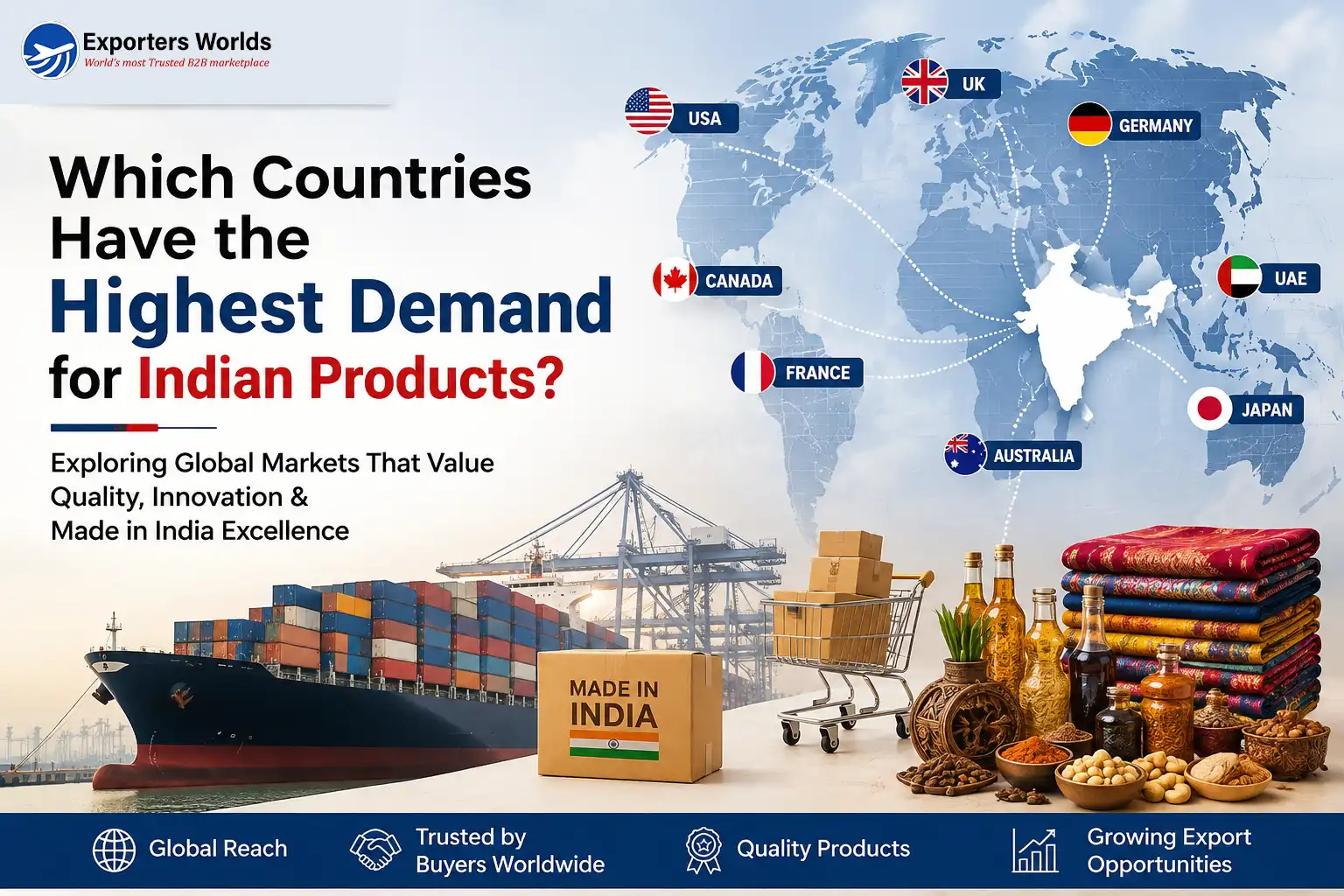
India has become one of the most important sourcing destinations for global buyers looking for everything from pharmaceuticals and textiles to engineering goods, food products, chemicals, handicrafts, jewellery, machinery, and consumer products.
For an Indian manufacturer or supplier planning to enter the import export business, however, one question matters more than simply knowing that global demand exists:
Which countries are actually buying Indian products, and where should exporters focus their efforts?
There is no single country that leads demand across every product category. The strongest export market for Indian pharmaceuticals may be very different from the strongest market for rice, textiles, machinery, jewellery, or handmade products.
That is why exporters should look at demand market by market and product by product.
The United States, the United Arab Emirates, several European countries, Saudi Arabia, Singapore, Bangladesh, Australia, and other major economies have historically been important destinations for Indian exports. More importantly, each market offers different opportunities depending on purchasing power, population, industrial requirements, consumer preferences, trade relationships, and product demand.
Understanding these differences can help businesses decide where to invest their time, marketing budget, buyer outreach, and export resources.
Why Global Buyers Import From India
Businesses around the world import from India for more than one reason.
India has an unusually diverse manufacturing and supply base. A buyer can source agricultural commodities, finished consumer products, industrial components, chemicals, textiles, pharmaceuticals, jewellery, machinery, and specialized handmade goods from the same country.
Cost competitiveness is another advantage, but price alone does not explain India's export strength.
Indian suppliers have developed capabilities across large-scale manufacturing, specialized production, private-label manufacturing, customized orders, traditional craftsmanship, and technical industries. This makes the country relevant to buyers ranging from small retailers to multinational companies.
Global buyers may also look to India to diversify their supplier networks rather than depend heavily on one manufacturing country.
For exporters, this creates opportunities. But succeeding internationally requires more than finding a country with a large economy. The right market is the one where demand aligns with your particular product, pricing, certifications, logistics, and buyer profile.
1. United States: One of the Biggest Opportunities for Indian Exporters
The United States remains one of the most commercially attractive markets for Indian products because of its enormous consumer economy, large business sector, and diverse sourcing requirements.
Indian suppliers sell a broad range of products to American businesses and consumers, including pharmaceuticals, engineering goods, textiles, apparel, jewellery, chemicals, food products, machinery, home furnishings, leather goods, and specialty products.
The US is particularly interesting because demand is not limited to large corporations.
Importers, wholesalers, distributors, independent retailers, e-commerce sellers, restaurant suppliers, ethnic grocery businesses, private-label brands, and niche product companies all source products internationally.
This creates opportunities at several levels of the supply chain.
Someone searching for things to bring from India to USA, for example, might immediately think of spices, handicrafts, garments, jewellery, tea, home decor, or specialty foods. Those categories can certainly offer opportunities, but commercial exporters should look beyond individual product popularity.
The more important questions are:
Does the product solve a clear buyer need?
Can it meet US regulations?
Is the landed cost competitive?
Can the supplier provide consistent quality and volume?
Are there distributors, wholesalers, or retailers already serving the category?
The US market can be highly rewarding, but buyers also tend to expect strong documentation, predictable fulfillment, professional communication, and reliable quality.
2. United Arab Emirates: A Major Gateway for Indian Trade
The UAE has long been an important commercial partner for Indian businesses.
Its significance comes not only from domestic demand but also from its position as an international trading and re-export hub connecting businesses across the Middle East, Africa, and other regions.
Indian exporters commonly find opportunities in food products, jewellery, textiles, machinery, engineering products, electrical goods, consumer products, building materials, chemicals, and various manufactured goods.
The large Indian diaspora also creates sustained demand for familiar food, apparel, cultural products, household items, and consumer brands.
For businesses new to exporting, the UAE can be particularly interesting because of its strong trading ecosystem and concentration of importers, distributors, wholesalers, and international buyers.
However, exporters should still evaluate local regulations, labeling requirements, product standards, payment terms, logistics, and distributor capabilities before entering the market.
A high-demand destination does not automatically guarantee a profitable export deal.
3. European Markets: Strong Demand With Higher Compliance Expectations
Europe represents a major opportunity for Indian exporters, but it should not be treated as one single market.
Countries such as Germany, the Netherlands, France, Italy, Spain, Belgium, and other European economies can have very different buyer expectations and product opportunities.
Indian suppliers sell textiles, garments, pharmaceuticals, chemicals, engineering goods, machinery, food products, leather goods, home furnishings, organic products, industrial materials, and numerous other categories into European markets.
European buyers can be attractive because many markets have substantial purchasing power and established import networks.
At the same time, compliance can be demanding.
Depending on the product, exporters may need to consider product safety requirements, certifications, chemical restrictions, packaging rules, labeling standards, environmental requirements, traceability, and other regulatory obligations.
This makes Europe a good example of why export opportunity should never be evaluated using demand alone.
A manufacturer may find substantial buyer interest but still struggle to convert that interest if its product documentation, certification, packaging, or manufacturing standards do not match market expectations.
For serious exporters, completing that preparation can also become a competitive advantage.
4. Saudi Arabia: Growing Opportunities Across Consumer and Industrial Categories
Saudi Arabia is another important destination for Indian suppliers.
Its large economy, infrastructure development, food requirements, retail sector, construction activity, and industrial demand create opportunities across multiple categories.
Indian exporters may find potential in food products, rice, spices, textiles, chemicals, engineering goods, machinery, construction-related products, consumer goods, and manufactured items.
The country's dependence on international sourcing for many product categories creates opportunities for reliable foreign suppliers.
Indian businesses exploring Saudi Arabia should pay particular attention to buyer verification, local regulations, certifications, packaging requirements, and commercial relationships.
Finding an inquiry is relatively easy in international trade. Finding a genuine buyer who has the authority, budget, requirement, and intention to purchase is considerably harder.
That distinction matters in every export market.
5. Singapore: Small Geography, Significant Trade Importance
Singapore is physically small, but its role in international commerce is much larger than its size suggests.
It functions as a major financial, logistics, and trading hub in Asia, making it relevant to Indian exporters seeking access to sophisticated buyers and regional distribution networks.
Opportunities can exist across food, chemicals, engineering goods, machinery, pharmaceuticals, consumer products, textiles, technology-related goods, and specialized industrial products.
Singaporean buyers often operate in highly competitive markets, so suppliers need to communicate their value clearly.
Competitive pricing helps, but so do consistency, specifications, certifications, delivery reliability, and professional documentation.
Singapore can therefore be useful not only as a sales destination but also as part of a broader Southeast Asian export strategy.
6. Bangladesh: Strong Demand Driven by Regional Trade
Neighbouring Bangladesh represents another significant market for Indian products.
Geographical proximity can provide logistical advantages compared with more distant export destinations.
Demand can extend across raw materials, machinery, textiles-related inputs, chemicals, agricultural products, food products, engineering goods, vehicles, industrial materials, and consumer products.
For Indian suppliers, shorter transport routes and established regional trade relationships can make Bangladesh commercially attractive.
However, proximity should not make exporters careless.
Payment arrangements, buyer credibility, documentation, tariffs, product requirements, and commercial terms still require proper verification.
International business becomes safer when exporters evaluate buyers with the same seriousness with which buyers evaluate suppliers.
7. Australia: A Valuable Market for Specialized Indian Products
Australia offers opportunities to Indian exporters across both business and consumer categories.
Indian food products, textiles, pharmaceuticals, engineering goods, jewellery, home products, machinery, specialty goods, and other manufactured products can find buyer interest in the country.
The growing Indian-origin population also supports demand for several food, cultural, lifestyle, and consumer categories.
Australian buyers, however, can have strict expectations regarding biosecurity, food standards, labeling, quality, and product compliance.
Exporters selling agricultural, food, plant-based, wooden, or related products should understand relevant import requirements before agreeing to supply.
Once again, demand is only one half of the equation.
The ability to satisfy the importing country's rules determines whether that demand can become sustainable business.
Which Indian Products Have Strong International Potential?
Instead of asking only which country imports the most from India, exporters should identify where their particular product has the best combination of demand, buyer accessibility, margins, compliance feasibility, and repeat-order potential.
Product categories with established international relevance include:
- Pharmaceuticals and healthcare products
- Engineering goods and machinery
- Chemicals
- Textiles and garments
- Gems and jewellery
- Rice, spices, tea and other food products
- Leather products
- Handicrafts and home decor
- Automotive components
- Electrical and electronic products
- Industrial materials
- Beauty, wellness and herbal products
- Agricultural commodities
The opportunities within each category can vary considerably.
A handicraft supplier may care more about US and European retailers than industrial buyers in another region. An engineering manufacturer may focus on distributors, manufacturers, contractors, or industrial procurement teams. A food exporter may prioritize markets with strong ethnic demand, foodservice distribution, or supermarket opportunities.
This is why identifying the right buyer matters just as much as identifying the right country.
How to Select the Best Export Market for Your Business
One of the biggest mistakes new exporters make is trying to approach buyers everywhere.
A better strategy is to shortlist markets systematically.
Start with product demand. Determine whether buyers in the target country already purchase your product category and what specifications they expect.
Then evaluate competition. If dozens of suppliers sell virtually identical products, you need a clear reason for buyers to choose you.
Next comes pricing.
Calculate the complete landed cost rather than looking only at your factory price. Freight, insurance, duties, certifications, packaging, commissions, warehousing, and other expenses can change the economics of a deal.
Regulation also deserves attention before buyer outreach begins.
Confirm whether your product requires particular certifications, testing, licenses, registrations, labels, or documentation.
Finally, investigate potential buyers carefully.
A promising overseas inquiry means very little until the buyer's business identity, purchasing requirement, payment ability, and commercial seriousness have been evaluated.
This is where the search for reliable import export vendors in India and genuine international buyers becomes a critical part of the export process.
Finding Buyers Is Often Harder Than Finding Markets
An exporter may know that the US, UAE, Europe, Saudi Arabia, or another country offers strong demand and still struggle to generate business.
Why?
Because market opportunity does not automatically create buyer access.
Exporters often encounter incomplete inquiries, intermediaries, price shoppers, unverified buyers, poorly matched requirements, and prospects with little intention of closing a deal.
That can consume considerable time.
The objective should therefore not be to collect the maximum number of inquiries. It should be to create conversations with buyers whose requirements genuinely match the supplier's capabilities.
A smaller number of qualified opportunities can be considerably more valuable than hundreds of random leads.
Turning Global Demand Into Real Export Opportunities
Successful international expansion usually requires three things working together:
The right market.
The right buyer.
And the ability to execute the transaction professionally.
This is where B2B marketplaces and export-support platforms can help businesses move from market research to actual commercial conversations.
Exporters Worlds is an Indian B2B marketplace designed to connect suppliers with genuine and verified buyers while supporting businesses through the broader export journey.
Its approach includes buyer verification and qualification, the Golden Leads System, account and marketplace-profile support, digital marketing, SEO assistance, export guidance, trade documentation support, and direct buyer-seller communication.
Rather than treating every inquiry as an equal opportunity, its model focuses on identifying serious buying requirements and building stronger connections between suppliers and potential customers.
For emerging exporters, that can be especially useful. Knowing that a particular country wants Indian products is valuable. Reaching suitable buyers within that country is what turns market demand into business.
Businesses looking to expand internationally can explore Exporters Worlds to understand how their products can be positioned in relevant markets and how verified buyer opportunities can support their export strategy.
The Bigger Opportunity for Indian Exporters
Global demand for Indian goods is not concentrated in one destination or one category.
The United States offers access to an enormous consumer and business market. The UAE combines domestic demand with regional trading influence. European countries provide high-value opportunities alongside stricter compliance expectations. Saudi Arabia continues to create opportunities across industrial and consumer segments. Singapore provides access to an influential Asian trade hub, while Bangladesh and Australia offer strong opportunities in specific product categories.
The strongest market for your business depends on what you sell and how well your capabilities match the buyer's expectations.
For anyone entering the import export business, the smartest move is not to chase every country simultaneously. Identify a few promising markets, understand their requirements, validate buyer demand, prepare your export documentation, and concentrate on qualified commercial relationships.
India already has products the world wants.
The next challenge is connecting the right Indian supplier with the right buyer in the right market.
Frequently Asked Questions
1. Which country has the highest demand for Indian products?
There is no single country that leads across every Indian product category. The United States, UAE, major European economies, Saudi Arabia, Singapore, Bangladesh, Australia, and several other markets are important destinations. The best country depends on the product being exported, buyer demand, regulations, pricing, and competition.
2. What products are commonly imported from India?
International buyers source pharmaceuticals, engineering goods, textiles, garments, chemicals, jewellery, rice, spices, tea, machinery, automotive components, handicrafts, leather goods, home furnishings, agricultural products, and many other items from India.
3. What are profitable things to bring from India to USA?
Potential opportunities include textiles, apparel, jewellery, spices, tea, specialty foods, handicrafts, home decor, wellness products, engineering products, and other niche goods. Profitability depends on demand, competition, duties, shipping costs, regulations, selling price, and the buyer or distribution channel.
4. How can I find genuine buyers for Indian products?
Exporters can use B2B marketplaces, trade exhibitions, industry associations, distributor outreach, chambers of commerce, digital marketing, search marketing, referrals, and professional buyer databases. Every potential buyer should be verified before significant commercial commitments are made.
5. Is the import export business profitable in India?
It can be profitable, but profitability is not automatic. Results depend on product selection, sourcing or manufacturing costs, overseas demand, logistics, duties, payment terms, competition, compliance requirements, and the exporter's ability to secure repeat buyers.
6. How do exporters choose the right country for their products?
Start by evaluating product demand, existing imports, buyer types, competition, pricing, regulatory requirements, shipping costs, trade barriers, and potential margins. Exporters should then shortlist a few markets and validate buyer interest before investing heavily in expansion.
7. How can Exporters Worlds help Indian exporters?
Exporters Worlds positions itself as a B2B marketplace and export-support platform connecting suppliers with verified buyers. Its services include buyer qualification, the Golden Leads System, marketplace-profile assistance, digital marketing, SEO support, export guidance, trade documentation assistance, and support designed to help businesses pursue relevant domestic and international opportunities.