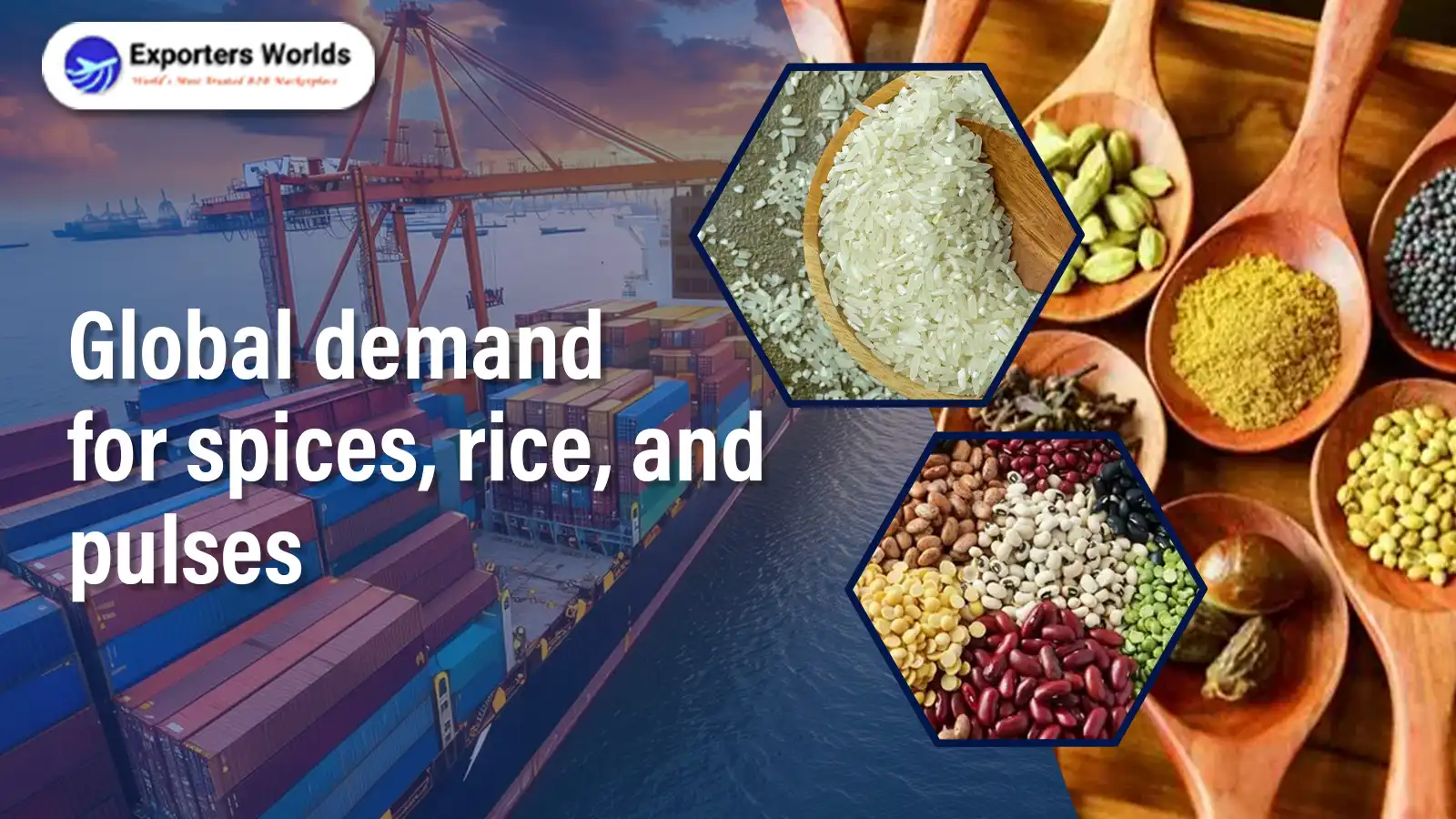
Global Demand for Spices, Rice, and Pulses:
Global Food Demand Context
Global food demand is rising steadily, but the real story lies in how it is changing. Agricultural consumption is expected to grow by nearly 13% by 2034, driven primarily by developing regions rather than mature economies. Countries across Africa and South Asia are shaping the future of food consumption through population growth, urban expansion, and rising incomes.
As diets evolve, consumption patterns are becoming more layered. Staples like rice and pulses continue to anchor food systems, while high-value categories such as bulk spices and organic seasoning are expanding at a faster pace. The growing preference for processed foods is further accelerating spice demand, while the global shift toward plant-based nutrition is increasing reliance on pulses.
Despite progress, food insecurity remains a pressing issue, affecting around 2.3 billion people globally. This reinforces the importance of staple commodities. Rice and pulses are not trend-driven products. They are essential to survival, making their demand highly stable and deeply rooted.
Global Rice Demand
Rice continues to dominate as one of the most critical staple foods worldwide. Global production in 2025 is estimated between 551 and 556 million tonnes, with supply currently exceeding demand. This has resulted in rising stock levels and downward pressure on prices.
At the same time, global rice trade has reached record levels of around 60.5 million tonnes. Demand is being driven largely by import-dependent regions such as Africa, Southeast Asia, and the Middle East. These markets rely heavily on consistent supply, particularly through rice export from India, which plays a central role in global trade flows.
Rice demand is highly inelastic. Consumption does not fluctuate significantly with price or income changes because it is directly tied to population and daily caloric intake. However, the current market is shaped by oversupply due to strong harvests and the normalization of export policies.
From a commercial perspective, rice offers unmatched demand stability and scalability. However, margins remain relatively low, and competition is intense. It is fundamentally a volume-driven business where efficiency, logistics, and reliable buyer networks determine success.
Global Pulses Demand
Pulses are emerging as one of the most dynamic segments in global agriculture. Demand has been growing at a rate of over 6% annually, outpacing many traditional cereal categories. This growth reflects a broader shift in how the world consumes protein.
Rising meat prices, increasing awareness of nutrition, and the global move toward plant-based diets are all fueling demand for pulses. In countries like India, pulses remain a primary protein source, while regions such as the Middle East and Africa depend on them for affordability and nutrition. Meanwhile, Western markets are adopting pulses as part of vegan and health-focused lifestyles.
The global trade landscape is equally active. India plays a dual role as both a major producer and importer, contributing significantly to pulses production in India while also supporting international demand through pulses export from India. Other key exporters include Canada and Australia, creating a diverse and interconnected supply chain.
From a business standpoint, pulses offer a compelling mix of growth and profitability. Demand is strong, margins are higher than staples, and opportunities for value addition are expanding through processed and ready-to-cook products. This makes pulses one of the most attractive segments for exporters looking to scale sustainably.
Global Spices Demand
The spices market operates in a completely different league. Unlike staples, it is driven by value rather than volume. Demand for wholesale spices and bulk spices is rising across both consumer and industrial segments.
The growth of processed and ready-to-eat foods has significantly increased spice consumption. At the same time, the globalization of cuisines has introduced diverse flavor preferences across regions. Ingredients like turmeric and ginger are also gaining traction for their health benefits, pushing the demand for premium and organic seasoning.
Beyond food, spices are widely used in pharmaceuticals, nutraceuticals, and cosmetics, further expanding their market scope. Key importing regions include the United States, Europe, and the Middle East, while countries like India, Vietnam, and Indonesia dominate exports.
This market comes with higher complexity. Quality standards are strict, especially in Western markets, and branding plays a critical role in differentiation. Price volatility is also higher compared to staples.
However, the rewards match the challenges. Spices offer high margins, strong branding potential, and significant export opportunities. For businesses that can meet quality and compliance standards, this segment presents substantial upside
Price and Market Volatility
Recent market trends highlight clear distinctions between these commodities. Rice prices have been declining due to oversupply, while pulses have remained relatively stable, supported by consistent protein demand. Spices, on the other hand, are experiencing upward but volatile price movements driven by their value-added nature.
These differences underline an important point. Each commodity requires a distinct strategy. What works for rice will not necessarily work for spices or pulses.
Demand Geography
Global demand is not evenly distributed. Different regions drive demand for different commodities.
Africa continues to lead in rice and pulses imports due to population growth and food security needs. The Middle East shows strong demand for pulses and spices, while Southeast Asia remains a key consumer of rice and spices. Meanwhile, Europe and the United States are driving demand for high-quality spices and health-focused pulse products.
This geographic variation makes it essential for exporters to adopt region-specific strategies rather than relying on a uniform approach.
Supply-Side Dynamics
Supply growth remains relatively slow, with global agricultural productivity increasing at less than 1% annually. This makes the market sensitive to disruptions.
Climate change is adding further pressure, especially on water-intensive crops like rice. With rice cultivation accounting for a significant share of global freshwater usage, long-term sustainability is becoming a concern.
Government policies also play a decisive role. Export restrictions, subsidies, and food security measures can shift trade flows rapidly, often overriding market fundamentals.
Value Chain and Commercial Structure
Each commodity operates within a different value chain.
Rice is largely scale-driven with minimal processing and limited branding opportunities. Pulses occupy a middle ground, offering moderate processing and growing branding potential. Spices, however, are heavily dependent on processing, quality control, and branding, making them more complex but also more profitable.
Understanding these differences is key to building an effective export strategy.
Key Opportunity Segments
In rice, opportunities lie in bulk exports and large-scale trade, where efficiency is critical. Pulses offer strong growth in packaged foods, ready-to-cook products, and plant-based protein segments. Spices provide premium opportunities in organic seasoning, blended products, and extracts.
Each category serves a different commercial purpose, and businesses often benefit from a diversified approach.
Future Outlook
Looking ahead, demand for rice will remain stable and closely tied to population growth. Pulses are expected to see strong expansion as protein consumption patterns evolve. Spices will continue to grow as a premium category, supported by processed food demand and global culinary trends.
At the same time, risks such as climate disruptions, trade restrictions, and cost inflation will continue to influence the market.
Final Strategic Evaluation
Rice offers stability and scale but limited margins. Pulses provide a balance of growth and profitability, making them a strong strategic choice. Spices deliver high margins and global demand but require higher expertise and compliance.
The most effective approach is not choosing one over the other, but understanding how each fits into a broader trade strategy.
Core Takeaways
Rice remains essential, stable, and volume-driven, forming the backbone of global food security. Pulses are emerging as the growth engine, driven by the global shift toward plant-based protein. Spices stand out as a high-margin, premium category with strong global demand.
What ties all of these markets together is the increasing complexity of international trade. Identifying genuine buyers, managing compliance, understanding regional demand, and executing deals efficiently have become critical challenges.
This is where structured platforms begin to make a real difference. Exporters Worlds, for instance, simplifies global trade by connecting businesses with verified buyers and suppliers while supporting every stage of the export process. Instead of navigating fragmented markets alone, exporters gain access to a more streamlined and reliable ecosystem.
For businesses dealing in bulk spices, wholesale spices, rice export from India, or pulses export from India, the opportunity is substantial. The real advantage lies in how effectively that opportunity is executed in a competitive and rapidly evolving global market.
Share Post :-
Latest Blogs