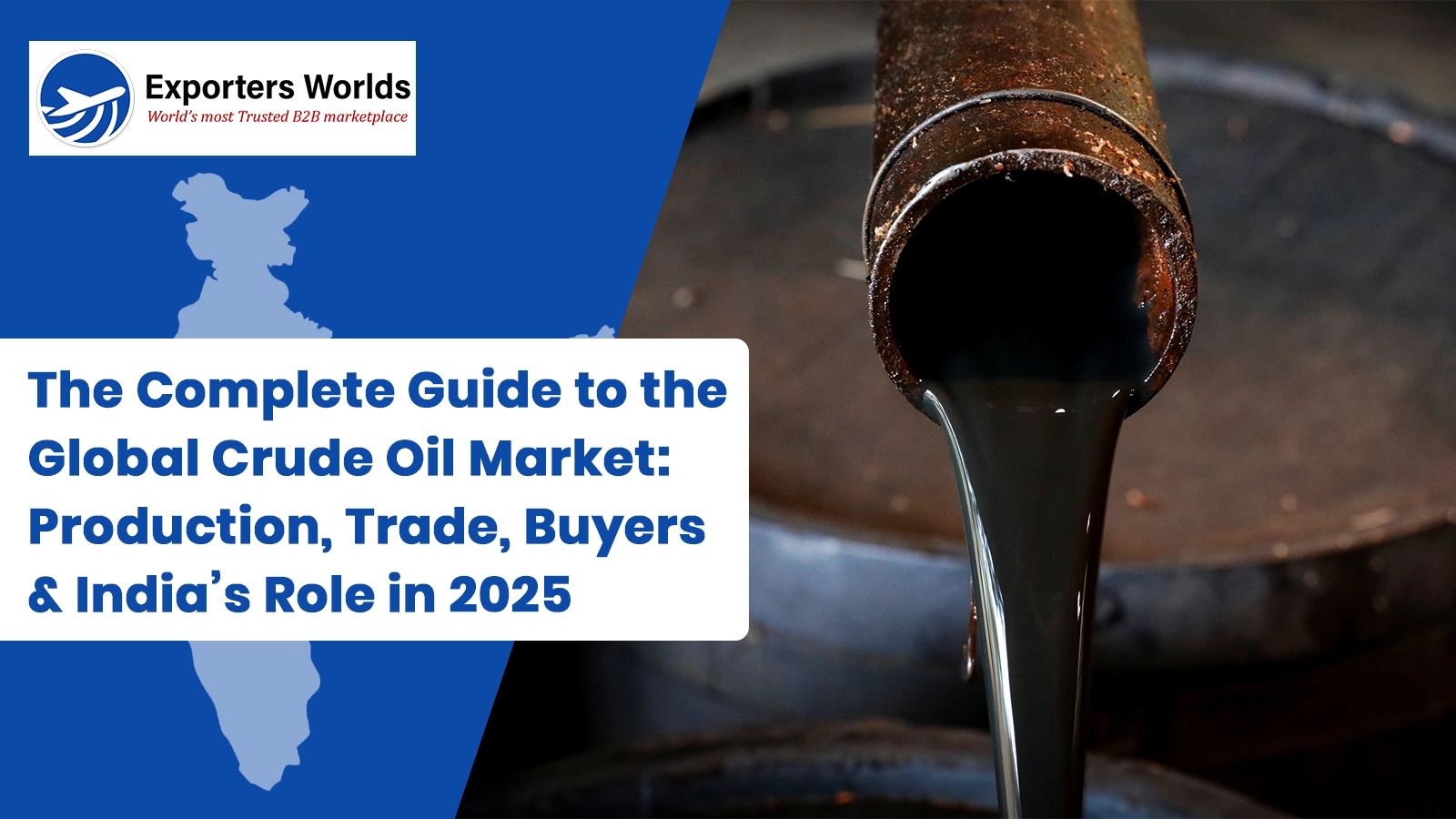
The Complete Guide to the Global Crude Oil Market: Production, Trade, Buyers & India’s Role in 2026
Introduction
The global crude oil market affects your business more than you might realize. Even as the world slowly shifts toward renewable energy, crude oil remains the undisputed backbone of global commerce. It fuels vehicles, powers heavy industries, and serves as the foundational raw material for everyday products like plastics, fertilizers, chemicals, and synthetic materials. Almost every modern economy depends on it to keep supply chains moving.
If you work as an exporter, supplier, manufacturer, or B2B trader, understanding how the global crude oil market operates in 2026 is no longer optional—it is critical for survival. The market has grown to an estimated valuation of over $3.18 billion, and navigating it requires sharp insight. Understanding the flow of this commodity helps you spot lucrative arbitrage opportunities, prepare for geopolitical supply chain risks, and reach the exact buyers who desperately need your supply.
In this comprehensive guide, you will get a clear, detailed, and actionable overview of the global crude oil ecosystem. You will learn exactly how crude oil is produced, the logistics of how it moves across borders, the profiles of the biggest buyers, and why India has cemented itself as one of the most important hubs for energy and trade decisions this year.
Understanding the Global Crude Oil Market in Simple Terms
The global crude oil market is the massive, interconnected system that covers everything from upstream exploration to downstream refining. This supply chain includes finding the oil deposits, extracting the liquid, transporting it via pipelines and supertankers, trading it on global exchanges, and finally processing it into usable products.
It is important to remember that crude oil is a raw, unrefined material, not a finished fuel like the petrol or diesel you put in a car. Its value on the open market fluctuates wildly based on three primary factors:
- Origin and Geopolitics: Where the oil comes from dictates its political risk and shipping costs.
- Chemical Quality: Refineries pay premiums for oil that is easier to process.
- Global Demand: Economic booms drive up demand for transportation and manufacturing fuels.
The Importance of Crude Oil Grades
Not all crude oil is created equal. Traders and refiners group crude oil based on two main chemical properties:
- Density (API Gravity): Classified as either light (flows easily) or heavy (thick and requires more energy to pump and refine).
- Sulfur Level: Classified as sweet (low sulfur content) or sour (high sulfur content, which requires extensive processing to meet environmental standards).
Most global refineries heavily prefer light and sweet crude oil. Because it is easier to refine, it yields a higher percentage of valuable products like gasoline and jet fuel, and produces cleaner emissions. This preference directly dictates global prices, shifts international trade routes, and controls buyer demand across the B2B market. For you as a trader or supplier, participating in this market involves more than just watching the Brent or WTI price tickers. It requires guaranteeing steady supply, ensuring smooth marine transport, following complex customs rules, and building long-term, reliable trade relationships.
Crude Oil Production: Where the Supply Comes From
Crude oil production is the starting point of the global market. Supply is highly concentrated; in fact, just two regions—North America and the Middle East—produce nearly 60% of the world's daily oil supply. The total global output currently hovers around 106 million barrels per day.
The major oil-producing regions include:
- The Middle East: The traditional powerhouse, home to massive conventional reserves and some of the lowest extraction costs on earth.
- North America: Driven by the United States' historic boom in hydraulic fracturing (fracking) and shale oil technology.
- Russia and Eurasia: Supplying massive volumes to Asian markets despite shifting geopolitical sanctions.
- Emerging Markets: Countries like Brazil (with deepwater pre-salt fields) and Guyana are rapidly growing as vital oil exporters.
Production does not happen in a vacuum. Global energy agencies constantly monitor how crude oil extraction reacts to political events, rig counts, and new drilling technology. Even a minor disruption at a major facility can send shockwaves through the supply chain.
The Top Crude Oil Producing Companies and Nations in the World
To succeed in B2B oil trading, you must know who controls the tap. In 2026, the United States remains the undisputed king of crude oil production, pumping out over 13.5 million barrels per day. However, they are closely followed by Saudi Arabia and Russia, both producing between 9 and 10 million barrels daily. The corporate side is dominated by massive state-owned entities (National Oil Companies) like Saudi Aramco and CNPC, alongside Western supermajors like ExxonMobil and Chevron. These giants dictate the pace of global supply and hold the leverage in international pricing.
- Take the Next Step: Want to know exactly which corporations and sovereign states control the market? Read our full breakdown on The Top Crude Oil Producing Companies in the World.
Top Crude Oil Exporters in the World
Producing oil is only half the battle; exporting it is what fuels the global economy. Countries like the US consume much of what they produce, making the export landscape look very different from the production charts. The Middle East remains the undisputed king of exports, with nations like Saudi Arabia, Iraq, and the UAE sending millions of barrels daily through vital chokepoints like the Strait of Hormuz to feed energy-hungry economies in Asia. Understanding these export volumes is crucial for predicting freight rates and supply availability.
- Take the Next Step: Discover which countries dominate global trade routes and hold the largest market share by reading Top Crude Oil Exporters in the World (Ranking by Export Volume & Global Share).
How Crude Oil Trade Works Across Borders
The crude oil trade is one of the most lucrative and complex commodity trades on the planet. Millions of barrels move across oceans every single day. Most global crude oil is sold through massive, long-term supply contracts between state producers and national refineries. However, spot market deals are equally vital, allowing traders to handle sudden spikes in demand or unexpected drops in supply.
The core pillars of international crude oil trade include:
- Logistics and Transport: Utilizing Very Large Crude Carriers (VLCCs), Suezmax tankers, and thousands of miles of transnational pipelines.
- Global Pricing: Pegged to regional benchmarks like Brent Crude (Europe/Global), West Texas Intermediate (WTI - North America), and Dubai/Oman (Middle East/Asia).
- Compliance and Rules: Navigating strict customs laws, international sanctions, insurance requirements, and evolving maritime environmental standards.
In the crude oil trade, trust is just as important as price. Buyers heavily favor suppliers who have a proven track record of delivering on time, maintaining strict quality controls, and communicating transparently during transit.
How to Import Crude Oil from Verified Suppliers
Breaking into the crude oil import business requires strict due diligence. Sourcing from unverified sellers can lead to massive financial losses, legal trouble, or seized cargo. A successful B2B import operation involves verifying the supplier's past performance, understanding Incoterms (like FOB or CIF), securing Letters of Credit from top-tier banks, and hiring independent inspection agencies like SGS to verify the quantity and quality of the oil before it is loaded onto the vessel.
Looking for a reliable supply chain? Skip the uncertainty and connect directly with vetted providers through our Global Crude Oil Supplier Directory. Every partner is pre-screened to ensure compliance with international maritime and financial standards.
- Take the Next Step: Ready to start sourcing safely? Follow our complete framework in How to Import Crude Oil from Verified Suppliers (Step-by-Step B2B Guide).
Who Are the Major Global Crude Oil Buyers?
If you are supplying crude, you need to know who is buying. The end-buyers in the crude oil market are rarely individuals; they are massive industrial complexes with the infrastructure capable of processing millions of barrels.
The primary buyers in the global market include:
- National Oil Companies (NOCs): Government-backed entities securing energy for their entire populations.
- Independent Refineries: Private corporations that buy crude to process into lucrative refined products.
- Energy Trading Firms: Massive commodity traders (like Vitol or Trafigura) that buy, store, and resell oil for a profit.
- Large Industrial Users: Sectors like aviation, shipping, and petrochemical manufacturing.
Asia remains the undisputed demand center of the global crude oil market. Rapid urbanization, expanding manufacturing sectors, and rising transportation needs keep import volumes incredibly high across the Asia-Pacific region. Modern buyers also look well beyond the price per barrel. They prioritize supply stability, flexible credit terms, and ESG (Environmental, Social, and Governance) compliance.
10 Proven Ways to Find Crude Oil Buyers with High Import Demand
Finding a legitimate buyer who is ready to issue an ICPO (Irrevocable Corporate Purchase Order) is the hardest part of the oil business. Gone are the days when trade relied solely on closed-door meetings in Geneva or Dubai. Today, successful suppliers use a mix of government tender portals, specialized B2B matchmaking platforms, international trade fairs, and direct outreach to refinery procurement mandates. Building a digital footprint and utilizing trade data to track which countries are facing domestic shortages are guaranteed ways to secure high-volume buyers.
- Take the Next Step: Stop chasing ghost buyers and learn the real acquisition strategies in 10 Proven Ways to Find Crude Oil Buyers with High Import Demand.
India’s Growing Role in the Global Crude Oil Market
No conversation about the 2026 global oil market is complete without focusing on India. As one of the fastest-growing major economies, India’s appetite for energy is insatiable. Because domestic production only covers a fraction of its needs, India operates with an import dependency hovering around 89%. This makes the country one of the most critical and lucrative destinations for crude oil suppliers worldwide.
India’s strength in the market comes from:
- Massive Refining Capacity: India is home to some of the largest and most complex refineries on earth, capable of processing cheaper, low-quality crude grades into high-value products.
- Strategic Sourcing: India aggressively diversifies its imports, buying from the Middle East, West Africa, the Americas, and Russia to minimize geopolitical risk.
- Export Powerhouse: India doesn't just consume; it refines imported crude and exports the finished petroleum products (like diesel and aviation fuel) back to global markets at a premium.
How Much Crude Oil Does India Import and Export?
The sheer volume of India's petroleum trade is staggering. In recent fiscal years, India's crude oil imports have surpassed 242 million tonnes annually. This massive intake fuels domestic consumption—which is rising sharply across high-speed diesel, petrol, and LPG—and feeds the export market. India ships out millions of tonnes of refined Petroleum, Oil, and Lubricant (POL) products every year, generating billions in revenue and off-setting its massive crude import bill.
- Take the Next Step: Get the exact tonnage, financial data, and product breakdowns in our detailed report: How Much Crude Oil Does India Import and Export?.
India Crude Oil Imports by Country Breakdown 2026
To guarantee energy security, India cannot rely on a single partner. While the Middle East (specifically Iraq and Saudi Arabia) has historically been the backbone of India's supply, recent years have seen a massive structural shift. Driven by favorable pricing and shifting global sanctions, Russia has rapidly become a top supplier to Indian refiners. At the same time, India continues to source from the US and emerging African markets to keep its supplier matrix balanced and highly competitive.
- Take the Next Step: Understand exactly where India's oil is coming from and spot the shifting trade corridors in India Crude Oil Imports by Country Breakdown 2026: A Complete Guide for Energy & Trade Decisions.
Top Crude Oil Importers In India 2025 – Industry Leaders & Insights
When supplying India, you are dealing with industry titans. The landscape is split between massive Public Sector Undertakings (PSUs) like Indian Oil Corporation (IOCL), Bharat Petroleum (BPCL), and Hindustan Petroleum (HPCL), which handle the bulk of domestic fuel needs. On the private side, giants like Reliance Industries (operating the world's largest refinery complex in Jamnagar) and Nayara Energy dominate the space, heavily driving the import of complex crude grades for export-focused refining.
- Take the Next Step: Learn how to navigate the Indian corporate landscape and identify key procurement targets in Top Crude Oil Importers In India 2025 – Industry Leaders & Insights.
Challenges Shaping the International Oil Market in 2026
While the market is massive, it is not without friction. The global crude oil market is currently characterized by slower, more stabilized growth compared to previous decades. Several critical challenges demand your attention:
- Geopolitical Flashpoints: Ongoing tensions in the Middle East and Eastern Europe continuously threaten to disrupt major supply routes and chokepoints like the Red Sea and the Strait of Hormuz. These disruptions cause immediate, violent spikes in freight costs and barrel prices.
- Price Volatility: The market has recently seen wild swings, with prices capable of doubling in a matter of weeks based on international conflict or sudden OPEC+ production cuts. This volatility wreaks havoc on national import bills and supplier margins.
- Stricter Environmental Regulations: The global push for decarbonization and net-zero emissions is forcing the industry to adapt. Carbon taxes and strict maritime shipping emissions laws are increasing the baseline cost of doing business.
- Financial and Insurance Hurdles: Securing maritime insurance and trade finance for cross-border oil shipments has become highly complex, especially when navigating international sanctions against specific producing nations.
Opportunities Despite the Challenges: Why Digital Platforms Matter
Even with these hurdles, the global crude oil market remains highly profitable for those who adapt. The era of relying exclusively on closed-door, traditional networking is over. Today, procurement officers and refinery buyers initiate their sourcing processes online.
If you want to capitalize on the 2026 market, you must embrace digital transformation. Using B2B portals allows you to:
- Bypass geographic limitations and reach qualified buyers globally.
- Instantly showcase your product specifications, past performance, and compliance certificates.
- Filter out unqualified leads and receive direct, serious ICPOs.
- Drastically reduce the time and capital spent on traditional marketing and international travel.
Being visible, transparent, and instantly accessible online is the single best way to separate your business from the thousands of unverified brokers in the market.
Conclusion: What the Global Crude Oil Market Means for You in 2026
The global crude oil market in 2026 rewards preparation, agility, and authority. Production is concentrated, trade routes are shifting, and massive buyers like India are constantly evolving their procurement strategies to secure the best possible deals.
Prices will always fluctuate, and geopolitical rules will continue to change, but the foundational demand for crude oil is not disappearing anytime soon. If you stay informed on regional import data, heavily vet your suppliers, and actively market your capacity, you will find incredibly strong opportunities for growth.
Success in this industry comes down to connections. Platforms like Exporters Worlds exist to bridge the gap, bringing verified exporters, suppliers, and high-volume buyers into one trusted digital ecosystem. By leveraging the right data and the right platform, you can scale your crude oil operations with confidence.
Stop searching for leads and start receiving verified offers.
If you are ready to streamline your procurement and bypass the risks of unverified brokers, the next logical step is to move from information to action. Use the Exporters Worlds RFQ Marketplace to submit your specific requirements and receive competitive, transparent quotes directly from vetted global suppliers. By leveraging a trusted digital ecosystem, you can scale your crude oil operations with total confidence.
FAQs
1. What exactly is the global crude oil market?
It is the worldwide system encompassing the exploration, extraction, transportation, trading, and refining of raw petroleum into usable industrial and consumer fuels.
2. Why is crude oil still a vital commodity in 2026?
Despite the rise of alternative energy, crude oil remains the irreplaceable foundation for global heavy transport, aviation, power generation, and the manufacturing of essential petrochemicals and plastics.
3. Who are the primary buyers of crude oil globally?
The largest buyers are nations with massive domestic energy deficits, state-owned national oil companies, independent private refineries, and massive global commodity trading houses.
4. Why does India hold so much power in the crude oil market?
India combines a massive, growing domestic demand with an 89% import dependency. Furthermore, it possesses some of the world's most advanced refineries, allowing it to import raw crude and export highly profitable refined fuels globally.
5. Is the global crude oil market expected to grow?
Yes, but the growth is stabilizing. While overall volume continues to rise driven by emerging markets in Asia and Africa, the rate of growth is slowing due to widespread environmental regulations, EV adoption, and global economic shifts.