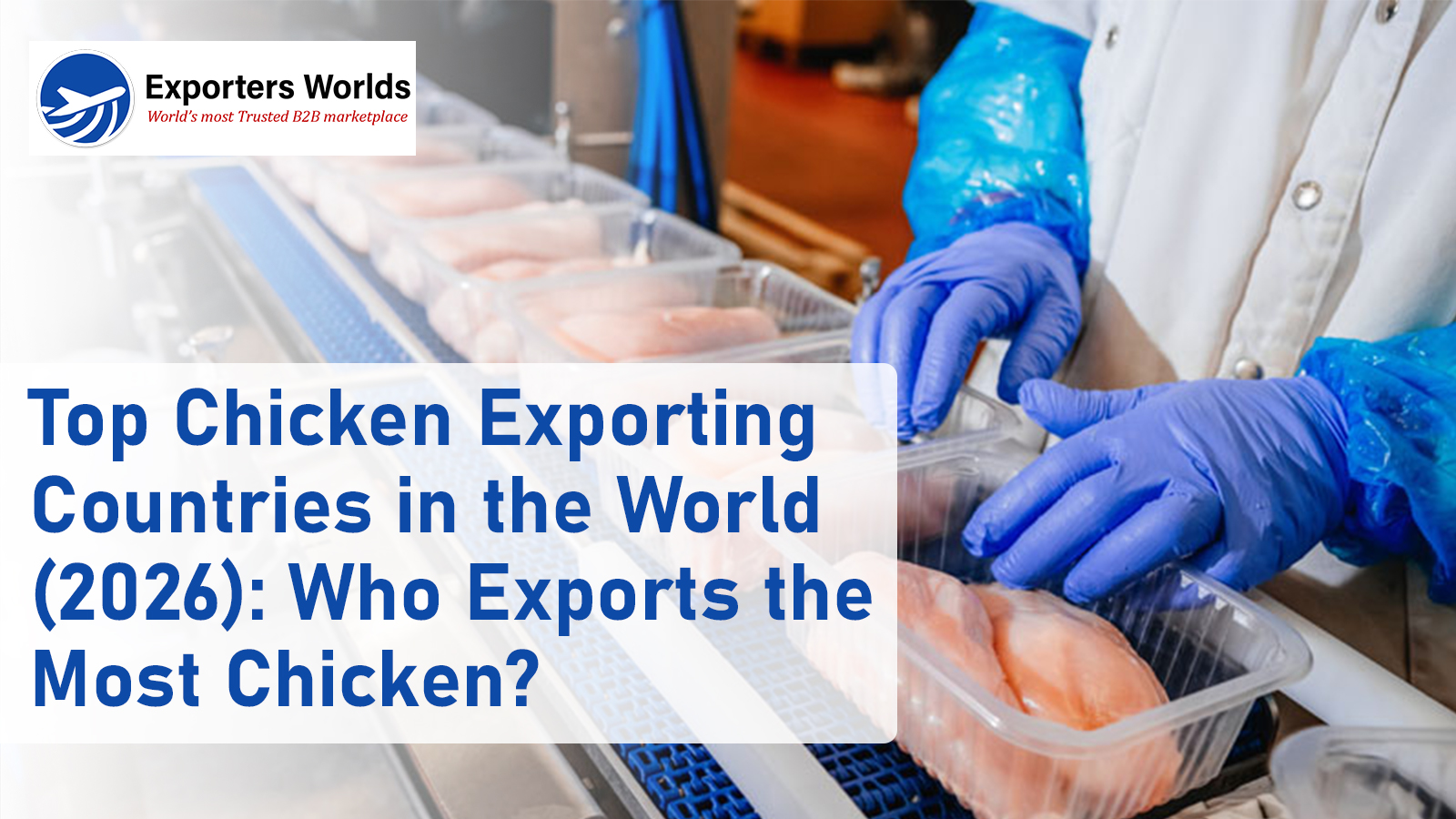
Top Chicken Exporting Countries in the World (2026): Who Exports the Most Chicken?
Introduction: Why the Global Chicken Export Market Matters in 2026
Chicken has quietly become the backbone of global protein consumption—and in 2026, it’s impossible to ignore its economic and strategic importance. As the most traded animal protein worldwide, chicken plays a crucial role in feeding growing populations, stabilizing food prices, and supporting cross-border agricultural trade.
Unlike beef or pork, chicken benefits from shorter production cycles, lower feed conversion ratios, and broader cultural acceptance. These advantages have fueled massive demand across Asia, the Middle East, Africa, and parts of Europe. For import-dependent nations, chicken isn’t just food—it’s food security.
This naturally leads to a core question shaping sourcing and investment decisions today: which country exports the most chicken, and what structural advantages allow it to dominate global markets? In this article, we analyze the top chicken exporting countries, examine export volumes by segment, unpack key market drivers, and explain how global buyers can navigate this complex trade environment more effectively—especially with the support of trusted B2B platforms like Exporters Worlds.
Global Overview of the Chicken Export Market (2026 Snapshot)
The chicken export market in 2026 is estimated to exceed USD 35 billion, with global export volumes continuing to grow steadily despite economic uncertainty. Chicken now accounts for a significantly larger share of traded animal protein than beef or pork, largely due to its affordability and adaptability across cuisines.
From a food security standpoint, chicken has become indispensable. Governments increasingly favor poultry imports because production is scalable, pricing is more stable, and supply chains recover faster after disruptions. As a result, the global poultry trade is becoming both broader and more specialized.
Trade flows reveal a clear pattern:
- Emerging markets prioritize volume and price competitiveness.
- Mature importers demand strict compliance, traceability, and value-added products.
At the center of this system are a handful of exporting nations that shape global supply. While several countries play important roles, one exporter consistently stands above the rest—cementing its position at the top of the top chicken exporting countries list.
Who Exports the Most Chicken in the World?
Brazil: The Undisputed Global Leader in Chicken Exports
Brazil remains the clear answer to which country exports the most chicken. In 2026, Brazilian chicken exports are forecast to reach approximately 5.5 million metric tons, representing nearly 35–36% of global exports.
Brazil’s dominance is structural, not cyclical. The country benefits from abundant corn and soy production, which significantly lowers feed costs—one of the largest expenses in poultry farming. Its poultry industry is intentionally designed for exports, with processing plants, cold chains, and ports optimized for international shipments.
Even during recent avian influenza disruptions, Brazil demonstrated resilience through rapid containment and regionalized disease management. By late 2025, major importing markets had reopened, reinforcing Brazil’s reputation as a reliable long-term supplier.
For international buyers, Brazil offers scale, consistency, and competitive pricing. Through Exporters Worlds, importers can access verified Brazilian poultry exporters, ensuring compliance, documentation accuracy, and smoother trade execution—critical factors when sourcing from the world’s largest chicken exporter in the world.
United States: High Production, Lower Export Dependency
The United States remains a poultry production powerhouse, exporting an estimated 2.9–3.0 million metric tons of chicken in 2026. However, unlike Brazil, the U.S. poultry industry is heavily oriented toward domestic consumption.
Strong internal demand limits export dependency, even though the U.S. excels in specific categories such as frozen leg quarters and dark meat cuts. Trade access is often influenced by sanitary regulations, bilateral agreements, and disease-related restrictions, which can temporarily limit export reach.
As a result, while the U.S. ranks high in chicken export volume by country, it does not aggressively pursue global market dominance in the same way Brazil does.
European Union: A Fragmented but Powerful Export Block
Collectively, the European Union exports around 1.8 million metric tons of chicken annually. However, this figure masks internal fragmentation. A large portion of EU poultry trade occurs within the bloc itself.
Poland has emerged as a leading exporter, particularly in chilled chicken, benefiting from efficient logistics and proximity to high-income markets. EU exporters compete less on price and more on sustainability, animal welfare, and traceability—factors increasingly valued by premium buyers.
Because EU regulations are complex, buyers often rely on intermediaries like Exporters Worlds to identify compliant suppliers and manage documentation efficiently.
Thailand: Processed Chicken Export Powerhouse
Thailand dominates the global market for value-added poultry. With exports expected to reach 1.1–1.2 million metric tons, Thailand controls approximately 41% of global processed chicken exports.
Rather than focusing on raw volume, Thailand has positioned itself as a premium supplier of cooked, ready-to-eat, and branded chicken products. Advanced food safety systems and rigorous traceability have earned Thailand strong footholds in Japan, South Korea, and other high-value Asian markets.
This makes Thailand a prime example of how specialization—not just scale—drives export leadership.
China: A Growing Force in Poultry Exports
China’s poultry exports are projected to reach around 800,000 metric tons in 2026. While China is better known as a major importer, its export capacity continues to expand, particularly in frozen and processed segments.
Large-scale automation, vertical integration, and cost efficiencies allow China to compete effectively in select global markets, reinforcing its dual role as both exporter and importer.
Market Segment Leadership: How Export Dominance Varies by Product Type
Export leadership changes dramatically depending on product type:
- Frozen Chicken Exports: Brazil leads due to price competitiveness and bulk supply capabilities.
- Chilled Chicken Trade: Poland and select EU nations dominate, where logistics speed and shelf life are critical.
- Processed and Cooked Chicken: Thailand leads globally in value, driven by branding and convenience-focused demand.
- Specialty Products (Feet & Paws): Brazil and the U.S. supply large volumes to Asian markets where demand remains consistently strong.
Understanding these distinctions is essential for smart sourcing decisions.
Key Market Drivers Shaping Chicken Exports in 2026
Disease Resilience and Trade Recovery
Countries that recover quickly from avian influenza outbreaks gain long-term trust and market share.
Regionalization Agreements
Exporting from disease-free zones ensures continuity and minimizes trade disruptions.
Cost Structures and Currency Effects
Lower feed costs and favorable currency movements significantly enhance export competitiveness.
Sustainability and Compliance Pressures
Environmental standards, animal welfare, and traceability now directly influence market access and pricing.
Emerging Chicken Exporters to Watch
- Turkey: Forecast to grow exports by 6% to 445,000 metric tons, expanding across the Middle East and Eurasia.
- Ukraine: Leveraging geographic proximity and competitive pricing to strengthen access to EU markets.
Top Global Chicken Importers Driving Export Demand
China leads imports of frozen cuts and chicken paws. Japan and South Korea remain premium markets for processed poultry. Meanwhile, the Middle East—especially the UAE and Saudi Arabia—continues to drive demand for Halal-certified whole chickens, supported by population growth and food security initiatives.
Commercial Insight: What This Means for Buyers, Traders, and Investors
For buyers, the key lies in aligning product needs with exporter strengths—balancing price, quality, and compliance. Diversifying sourcing across regions reduces exposure to disease outbreaks and policy changes.
This is precisely where Exporters Worlds delivers unmatched value. As a comprehensive B2B marketplace, it connects buyers with verified poultry exporters worldwide, offers export documentation assistance, ensures compliance with international trade standards, and provides data-driven market intelligence—helping businesses trade with confidence, not guesswork.
Conclusion: The Future of the Global Chicken Export Market
Brazil’s leadership as the world’s top chicken exporter remains firmly established in 2026. Yet the broader poultry trade is becoming more segmented, more regulated, and more opportunity-rich. Different countries dominate different product categories, and success increasingly depends on strategic sourcing and reliable partnerships.
In this evolving landscape, understanding export leaders is no longer optional—it’s a competitive necessity.
Looking to source chicken internationally, identify reliable poultry exporters, or stay ahead of global export trends?
Partner with Exporters Worlds—your trusted B2B platform for verified chicken exporters worldwide, seamless trade support, and smarter global sourcing decisions in 2026 and beyond.
Frequently Asked Questions (FAQs)
1. Which country exports the most chicken in the world?
Brazil is the world’s largest chicken exporter, accounting for approximately 35–36% of global chicken exports in 2026. Its dominance is driven by low feed costs, export-focused infrastructure, strong disease management systems, and broad market access across the Middle East, Asia, and Africa.
2. Why is Brazil the largest chicken exporter in the world?
Brazil’s leadership in chicken exports is structural rather than temporary. The country benefits from abundant corn and soy production, vertically integrated poultry operations, competitive pricing, and ports optimized for frozen meat exports. Brazil also maintains strong compliance with Halal and international food safety standards, making it a preferred supplier for global importers.
3. Which countries are the top chicken exporting countries besides Brazil?
Beyond Brazil, the leading chicken exporting countries include the United States, Poland and other EU nations, Thailand, and China. Each specializes in different segments—such as frozen cuts, chilled chicken, or processed poultry—serving diverse global markets with varying compliance and pricing requirements.
4. What type of chicken products are most commonly exported globally?
Frozen chicken products dominate global exports due to longer shelf life and easier logistics. These include whole frozen chickens, leg quarters, wings, and mechanically deboned meat. Processed and cooked chicken products—led by Thailand—are also growing rapidly, especially in premium Asian and developed markets.
5. How do buyers find reliable chicken exporters from top exporting countries?
Buyers typically identify reliable chicken exporters by verifying certifications, export history, cold-chain capabilities, and compliance with destination-country regulations. Many international buyers use B2B sourcing platforms to connect with verified poultry exporters, compare suppliers by country, and manage trade inquiries more efficiently.