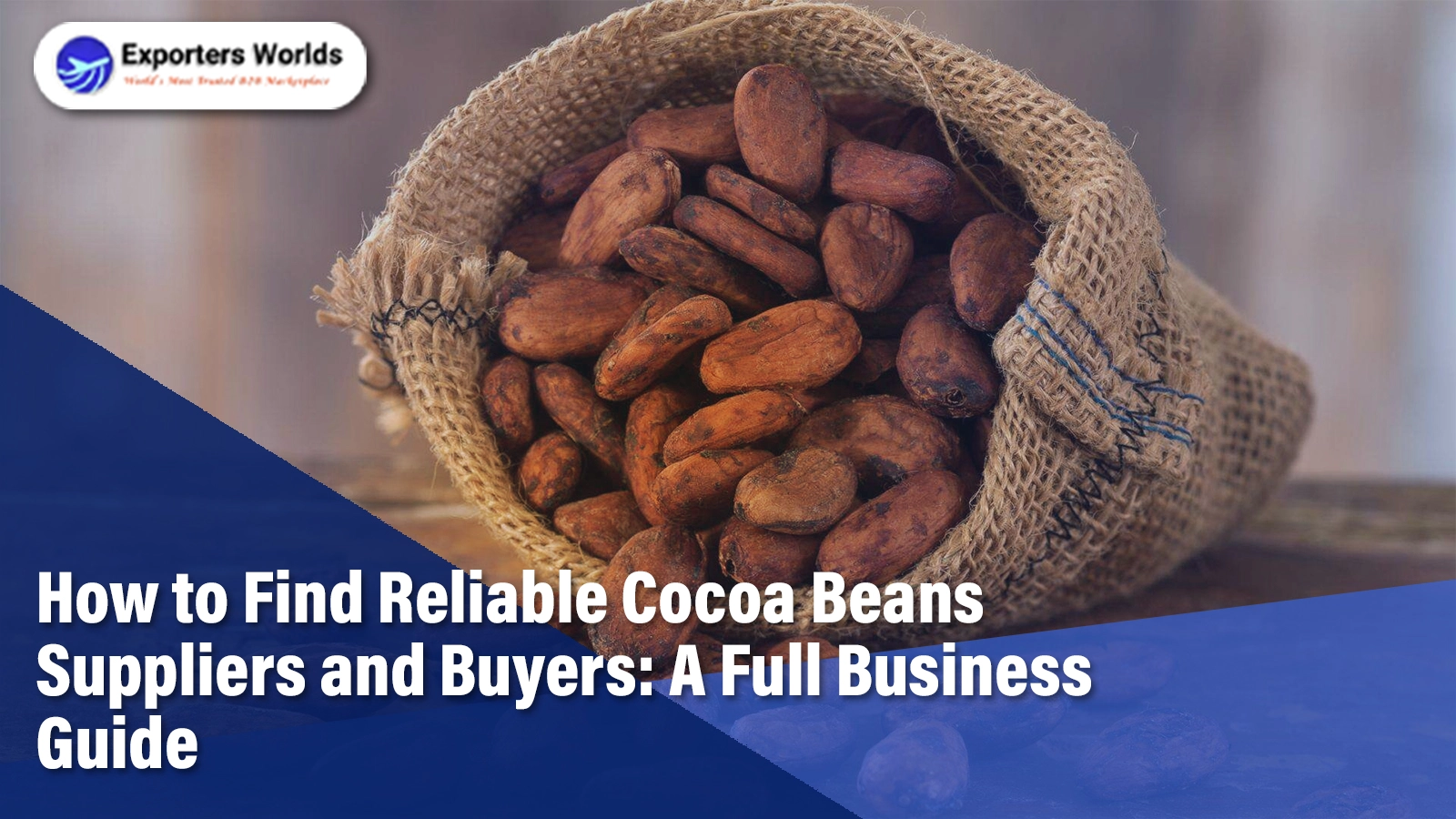
How to Find Reliable Cocoa Beans Suppliers and Buyers: A Full Business Guide
Introduction: Why Finding the Right Cocoa Beans Suppliers and Buyers Isn’t as Simple as It Sounds
The first time I explored sourcing agricultural commodities, I assumed finding cocoa beans suppliers would be as simple as browsing a B2B directory and sending a few emails. It wasn’t.
Within weeks, I realized the cocoa trade operates on layers most newcomers don’t see at first glance — fluctuating global prices, certification complexities, origin-level politics, shipping variables, and buyers who scrutinize every detail from fermentation level to moisture content.
Here’s the reality: global cocoa production exceeds 5 million metric tons annually, according to ICCO data. Nearly 70% of that comes from Africa, led by Côte d’Ivoire and Ghana. Meanwhile, demand keeps rising — especially in Asia-Pacific markets — as chocolate consumption grows steadily across emerging economies.
At the same time, buyers today demand more than just beans. They want traceability. Ethical sourcing. Sustainability certifications like Fairtrade, Rainforest Alliance, and Organic. They want documentation aligned with EU and US regulations. And they want reliability.
That’s why finding the right cocoa beans buyers and suppliers isn’t just a sourcing task — it’s a strategic business decision.
This guide breaks down how to:
- Identify reliable cocoa beans suppliers
- Connect with serious cocoa beans buyers
- Navigate compliance and documentation
- Structure pricing and payment terms
- Manage logistics and risk
- Build long-term trade relationships
Let’s start with the foundation. Note: If you are new to the broader mechanics of international freight, customs compliance, and supply chain risk, we highly recommend reading our complete guide to importing agricultural products in bulk alongside this commodity-specific guide.
Understanding the Global Cocoa Market Before You Trade
Global Production & Demand Trends
Cocoa isn’t evenly distributed across the globe.
- Côte d’Ivoire supplies roughly 40% of global cocoa.
- Ghana contributes around 20%.
- Indonesia, Ecuador, and Nigeria also play major roles.
- Europe processes over 35% of global cocoa beans, making it the largest importing region.
Demand trends show strong growth in:
- Premium and single-origin cocoa
- Organic-certified beans
- Sustainably sourced supply chains
In my experience analyzing commodity trade flows, traders who skip understanding origin dynamics often misprice contracts. They focus on FOB price alone, ignoring harvest cycles or regional political stability — and that’s where margin leaks begin.
Price Volatility and Market Drivers
Cocoa prices fluctuate — sometimes sharply.
Major drivers include:
- El Niño and extreme weather disruptions
- Political instability in producing countries
- Supply shortages and surplus cycles
- ICE futures benchmarks
- Sustainability regulations (such as EU deforestation compliance laws)
Action Insight:
Before signing long-term contracts with cocoa beans suppliers, track ICE futures and ICCO quarterly reports. Locking contracts without market awareness can erase your margin overnight.
Defining Your Business Model: Supplier, Buyer, Trader, or Processor?
Before reaching out to cocoa beans suppliers or cocoa beans buyers, you need clarity.
Are you:
- A chocolate manufacturer?
- A commodity trader?
- A distributor?
- A private-label brand?
Your role impacts everything:
- Minimum order quantity (MOQ)
- Certification requirements
- Warehousing needs
- Payment terms (LC vs T/T)
- Cash flow cycles
I’ve seen new entrants jump into full container loads without calculating storage capacity or working capital. The deal looked profitable — until warehouse rent and delayed payments crushed liquidity.
Clarity prevents costly enthusiasm.
How to Identify Reliable Cocoa Beans Suppliers
Where to Find Cocoa Beans Suppliers
You can source through:
- International B2B platforms
- Trade fairs (Gulfood, SIAL, Salon du Chocolat)
- Direct origin cooperatives
- National export promotion boards
But location alone doesn’t equal reliability.
Evaluate Supplier Credibility
Price should never be your first filter.
Look for:
- Fairtrade certification
- Rainforest Alliance
- UTZ
- Organic certification
- ISO / HACCP compliance
- Export documentation readiness
- Shipment references
A professional supplier should provide transparent traceability and clear documentation.
Red Flags
Watch for:
- Refusal to send samples
- Vague answers about origin
- Inconsistent paperwork
- Unclear moisture levels (export quality typically ~6–8%)
If answers feel evasive, trust that instinct.
Quality Parameters to Verify
Always assess:
- Bean size and uniformity
- Moisture content
- Fermentation level
- Mold presence
- Cut test results
Action Insight:
Request a third-party inspection (SGS or accredited lab) before releasing final payment.
Understanding HS Codes, Compliance & Documentation
Cocoa beans fall under HS Code 180100.
Essential Export Documents
- Commercial Invoice
- Packing List
- Bill of Lading
- Certificate of Origin
- Phytosanitary Certificate
- Quality/Inspection Certificate
Regulatory Considerations
- EU Maximum Residue Limits (MRLs)
- US FDA import standards
- NPPO compliance
- Organic validation (if applicable)
In international trade, shipments are often delayed not because of product issues — but because of documentation errors.
Paperwork can determine profitability.
Commercial Negotiation: Pricing, Incoterms & Payment Terms
Pricing Structure
Cocoa pricing depends on:
- ICE futures benchmark
- Origin differential
- Bean grade
- Certification premium
- Seasonal supply
Incoterms
Commonly used:
- FOB
- CIF
- CFR
Payment Methods
- Letter of Credit (LC)
- Telegraphic Transfer (T/T)
- Documents Against Payment
- Open account (long-term trust only)
Strategic Advice:
Model your full landed cost before signing:
- FOB price
- Freight
- Insurance
- Import duty
- Port charges
- Inland transport
Margin exists in precision — not guesswork.
Logistics & Storage Considerations
Cocoa beans are durable but not invincible.
Key Logistics Points
- Use dry containers with moisture control
- Consider container liners
- Transit time: 2–6 weeks by sea
Risk Management
- Moisture absorbers
- Temperature and humidity loggers
- Cargo insurance
I’ve seen shipments downgraded purely due to humidity mismanagement. Quality loss equals financial loss.
Finding Serious Cocoa Beans Buyers
Now let’s flip the lens.
Where to Find Cocoa Beans Buyers
- Chocolate manufacturers
- Cocoa processors
- Commodity traders
- Specialty bean-to-bar brands
- Regional distributors
Building Buyer Trust
Serious cocoa beans buyers want:
- Detailed specifications
- Consistent supply capability
- Certifications upfront
- Transparent origin data
Commodity sellers compete on price. Premium sellers compete on story, traceability, and quality.
Risk Factors Every Cocoa Trader Must Watch
Seasonality
Main crop vs mid-crop impacts pricing cycles.
Regulatory Tightening
EU deforestation compliance rules are reshaping sourcing strategies.
Quality Rejection
High moisture, mold, pest contamination — all costly.
Market Volatility
Futures-driven swings and currency fluctuations can wipe margins.
Risk awareness separates traders from long-term operators.
Financial Planning & Cash Flow Strategy
Cocoa trading is capital-intensive.
Typical Costs
- FOB bean price
- Freight & marine insurance
- Import duties
- Warehousing
- Inspection & lab testing
Cash Flow Planning
- Align payment cycles carefully
- Account for 30–60 day transit time
- Maintain liquidity buffers
Trade doesn’t usually fail because of demand. It fails because of poor cash flow planning.
Building Long-Term Supplier & Buyer Relationships
Sustainable trade isn’t transactional.
Best Practices
- Regular performance reviews
- Post-shipment evaluations
- Transparent dispute handling
- Gradual contract scaling
Long-Term Strategy
- Lock annual contracts
- Diversify origin sources
- Develop private-label collaborations
The cocoa market rewards consistency.
Digital Tools & Data Tracking for Cocoa Trade
Modern traders leverage:
- Trade analytics platforms
- HS code import/export trackers
- CRM systems
- Commodity price alert tools
Data improves timing. Timing improves margins.
Future Trends in Cocoa Trade
The cocoa industry is evolving fast.
- Asia-Pacific demand rising sharply
- Premium growth in organic and single-origin cocoa
- Blockchain-based traceability systems
- ESG-focused procurement policies
The global chocolate market is projected to exceed $180+ billion in the coming years — reinforcing upstream demand for structured cocoa supply chains.
Interesting Facts
- Over 90% of global cocoa farms are smallholder-operated.
- Fermentation alone can influence up to 60% of flavor profile development.
- Europe grinds more cocoa than it produces, relying heavily on imports.
- Sustainability premiums can increase bean value by 5–20%.
- Cocoa trees take 3–5 years to produce viable harvests.
Understanding these fundamentals helps you negotiate smarter — and source responsibly.
Conclusion: The Difference Between a Transaction and a Sustainable Cocoa Business
Finding reliable cocoa beans suppliers and connecting with serious cocoa beans buyers isn’t about chasing the lowest price.
It’s about:
- Understanding the global market before entering
- Vetting suppliers beyond surface-level claims
- Structuring contracts intelligently
- Managing documentation and compliance carefully
- Protecting quality through logistics precision
- Preparing financially for volatility
Sustainable cocoa trade isn’t built on cost alone — it’s built on transparency, compliance, data-driven decisions, and long-term relationships.
For businesses navigating this complexity, the challenge often isn’t just finding contacts — it’s finding verified networks, structured workflows, export guidance, compliance clarity, and buyer-supplier matchmaking under one ecosystem.
This is where platforms like Exporters Worlds quietly change the equation.
As a leading B2B marketplace connecting verified suppliers and buyers globally, Exporters Worlds simplifies partner discovery, strengthens trade credibility through background checks, supports export documentation processes, and helps businesses build sustainable international relationships — rather than one-off transactions.
If you're serious about entering or expanding in the cocoa trade, start with structured due diligence, a precise landed cost model, and a verified partner network.
Because in cocoa trading, smart groundwork doesn’t just reduce risk — it defines long-term success.
Frequently Asked Questions (FAQs)
What certifications should reliable cocoa beans suppliers have?
Fairtrade, Rainforest Alliance, Organic, UTZ, and internationally recognized food safety certifications.
How can I verify the authenticity of a cocoa beans supplier?
Request third-party inspection reports, shipment references, product samples, and export documentation history.
What is the typical moisture content for export-quality cocoa beans?
Generally around 6–8% to prevent mold and degradation.
How are cocoa beans priced internationally?
Prices are based on ICE futures benchmarks plus origin differentials and quality premiums.
What are common risks when importing cocoa beans?
Documentation errors, quality rejection, moisture damage, regulatory non-compliance, and price volatility.
Is cocoa trading profitable for small businesses?
Yes — but only with disciplined cost modeling, strong supplier vetting, and reliable buyer networks.