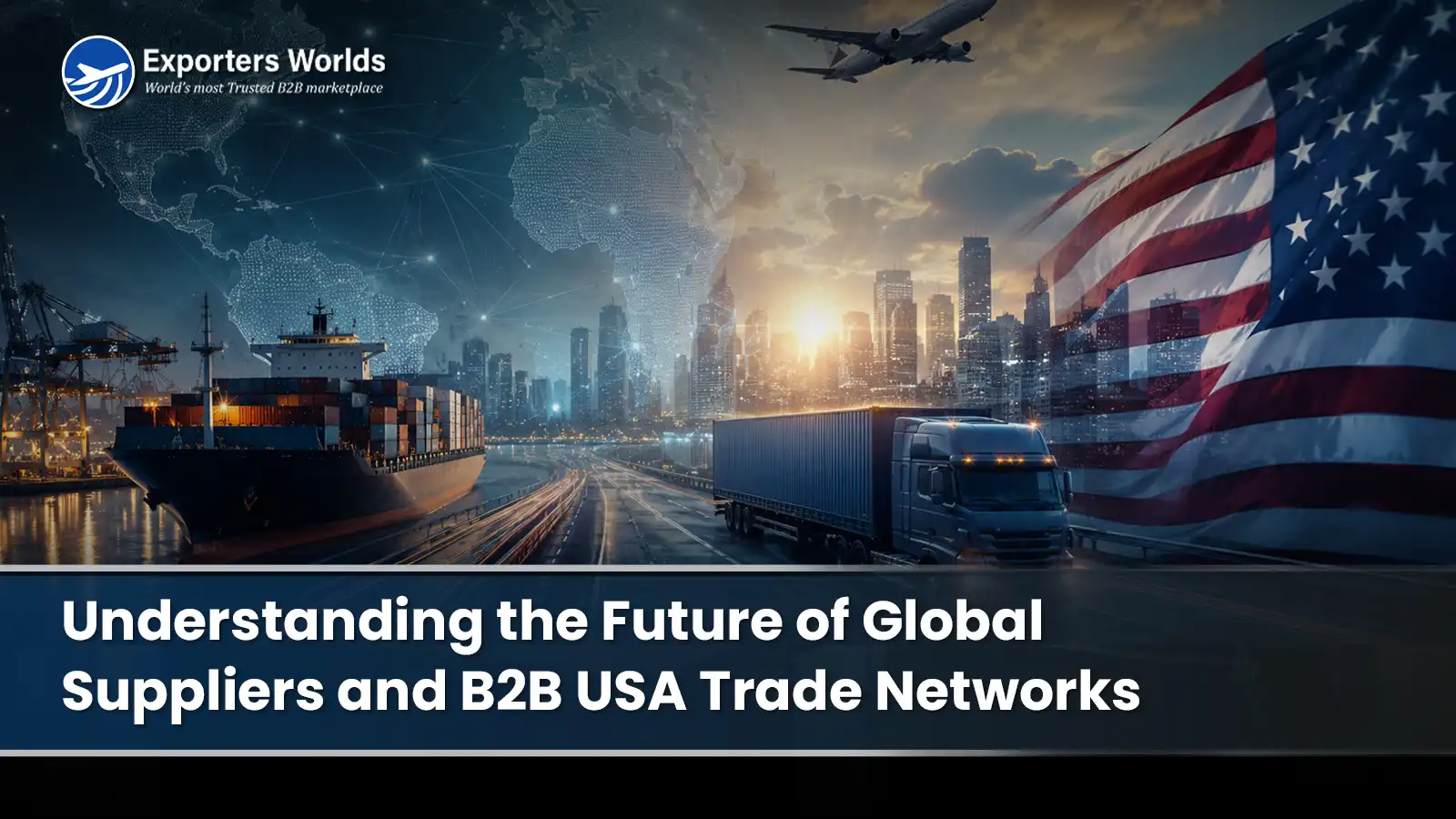
Understanding the Future of Global Suppliers and B2B USA Trade Networks: A Detailed 2026 Outlook
Introduction: The Era of Cheap Global Sourcing Is Quietly Ending
A few years ago, global procurement conversations usually started with one question: Who can manufacture this cheaper? Today, that question sounds incomplete. One shipping disruption in the Red Sea, one tariff escalation between major economies, or one compliance investigation can wipe out months of profitability almost overnight.
The old era of cost-first globalization is steadily giving way to something far more complex: resilience-first trade strategy.
Across b2b usa ecosystems, businesses are rethinking everything from sourcing diversification to logistics visibility, compliance readiness, and geopolitical exposure. Procurement leaders who once optimized purely for price are now balancing risk, speed, traceability, and digital integration alongside cost efficiency.
This shift is not theoretical. According to recent industry data, nearly 82% of supply-chain leaders reported tariff-related disruptions affecting operations in 2025. At the same time, U.S. sourcing dependence on China continues declining as ASEAN nations and India gain strategic relevance in global manufacturing.
This transformation is also accelerating because several powerful forces are colliding simultaneously:
- AI-driven procurement systems
- China+1 sourcing strategies
- Nearshoring and regional manufacturing
- ESG compliance pressure
- Digital commerce expansion through the modern b2b marketplace ecosystem
Trade is not collapsing. It is evolving into a system that is more regionalized, digitized, politically sensitive, and data-driven than ever before.
For modern global suppliers, this new environment creates both enormous opportunity and serious pressure. Businesses that adapt quickly may thrive for the next decade. Those relying on outdated sourcing assumptions may struggle to stay competitive.
The Structural Shift Reshaping Global Suppliers and Trade Networks
Why the Old Global Trade Model Worked for So Long ?
Between 1995 and 2019, the global sourcing formula appeared almost unbeatable.
Manufacturing naturally concentrated where labor costs were lowest, logistics systems became increasingly predictable, and companies optimized around lean inventory management. The dominant philosophy was simple: reduce costs aggressively and maximize efficiency.
This was the golden age of:
- Just-in-time logistics
- China-centric production ecosystems
- Hyper-globalized manufacturing
- Cost-driven supplier selection
Large wholesale distributors built highly optimized supply chains around this model. Containers moved predictably, lead times remained stable, and procurement teams often viewed long-distance sourcing as routine operational practice.
Predictability itself became an invisible assumption.
That assumption no longer holds the same weight.
The vulnerabilities hiding beneath the old system became painfully visible during:
- COVID-era factory shutdowns
- Global shipping container shortages
- Severe port congestion
- U.S.-China tariff conflicts
- Energy market instability across Europe and Asia
One delayed shipment suddenly affected entire production schedules. One geopolitical dispute disrupted procurement forecasts for months. Businesses discovered that low-cost sourcing can become extremely expensive when resilience is absent.
How the New Trade Architecture Is Being Built
The Rise of “Risk-Adjusted Efficiency”
Modern procurement strategies no longer focus only on minimizing unit costs. Instead, companies increasingly prioritize:
- Supplier diversification
- Manufacturing redundancy
- Real-time supplier visibility
- Regional production capabilities
The shift happening now is profound.
Businesses are moving from:
- Just-in-time → Just-in-case
- Single-country sourcing → Multi-country sourcing
- Manual procurement → AI-assisted procurement
This transformation reflects a broader realization: resilience is now a financial strategy, not merely an operational concern.
A delayed shipment today can trigger contractual penalties, inventory shortages, lost customers, and investor pressure. Because of that, boards and executive teams increasingly view supply-chain resilience as directly connected to profitability.
Why Globalization Is Becoming Regional Instead of Borderless
Globalization is not disappearing. It is reorganizing itself into regional trade clusters.
This phenomenon, often called “regionalized globalization,” is reshaping trade flows across the world.
Key regional developments include:
- North American manufacturing corridors expanding through Mexico
- ASEAN manufacturing clusters growing rapidly
- European strategic sourcing hubs becoming more localized
Rather than shrinking, global trade is becoming more geographically strategic.
Businesses now prefer supplier ecosystems closer to end markets because shorter logistics routes reduce exposure to disruptions, tariffs, and transportation volatility.
The China+1 Strategy and the New Geography of Global Suppliers
Why Companies Are Diversifying Beyond China
China remains one of the world’s most powerful manufacturing economies. However, companies increasingly avoid concentrating all production there.
This approach is known as the China+1 strategy.
Instead of abandoning China entirely, businesses continue using Chinese manufacturing while gradually shifting incremental production capacity into other countries.
Several factors drive this transition:
- Tariff volatility
- Geopolitical tensions
- Supplier concentration risks
- Export controls
- Regulatory scrutiny
The objective is diversification, not separation.
A company producing electronics, for example, may continue sourcing components from China while moving assembly operations to Vietnam or India to reduce geopolitical exposure.
Countries Emerging as Future Supplier Powerhouses
India’s Expanding Role in Global Manufacturing
India is becoming one of the most strategically important manufacturing alternatives in global trade.
Several advantages support this rise:
- Massive labor availability
- English-speaking business ecosystem
- Expanding digital infrastructure
- Government manufacturing incentives
India is seeing major growth in:
- Electronics manufacturing
- Pharmaceuticals
- Engineering goods
- Automotive components
Its digital trade ecosystem is also evolving rapidly, enabling stronger integration with global procurement systems.
Still, challenges remain.
Infrastructure gaps, logistics bottlenecks, and supplier fragmentation continue affecting operational consistency in certain sectors. Yet despite these issues, India’s long-term trajectory remains highly attractive for international sourcing diversification.
Vietnam’s Manufacturing Momentum
Vietnam has emerged as a major manufacturing hub for:
- Consumer electronics
- Furniture
- Apparel
- Consumer goods
Global companies increasingly view Vietnam as a flexible production base with strong export capabilities.
However, Vietnam still depends heavily on upstream Chinese components in many industries. This means complete supply-chain independence from China remains difficult even when production shifts geographically.
Mexico and the Nearshoring Boom
Mexico is rapidly becoming central to modern b2b usa trade ecosystems.
Its advantages are highly practical:
- USMCA trade benefits
- Faster shipping timelines
- Reduced geopolitical risk
- Easier North American coordination
A U.S. importer sourcing industrial components from Mexico can often reduce shipping timelines from several weeks to only a few days.
That speed advantage alone significantly improves inventory management and operational flexibility.
Indonesia, Thailand, and the EV Supply Chain Shift
Countries like Indonesia and Thailand are becoming increasingly important in:
- EV battery production
- Semiconductor ecosystems
- Chemicals manufacturing
- Industrial supply chains
Indonesia, in particular, benefits from large nickel reserves that support electric vehicle battery manufacturing growth.
How Digital B2B Commerce Is Transforming Trade Networks
The Rapid Evolution of the Modern B2B Marketplace
The modern b2b marketplace is replacing fragmented procurement workflows that once depended heavily on spreadsheets, emails, and disconnected supplier databases.
Traditional sourcing processes were often slow, opaque, and manually intensive.
Today’s systems increasingly provide:
- Integrated procurement platforms
- AI-assisted supplier discovery
- Real-time sourcing ecosystems
- Automated procurement workflows
This transformation is making global trade significantly more data-driven.
Platforms Reshaping B2B USA Procurement
Several major ecosystems now shape digital procurement:
- Alibaba
- Amazon Business
- Thomasnet
- Global Sources
- Faire
These platforms no longer function only as supplier directories.
They increasingly offer:
- Logistics support
- Financing solutions
- Compliance verification
- Supplier analytics
- Procurement automation tools
The digitalization of trade is fundamentally changing how buyers evaluate suppliers.
Why Digital Buyer Expectations Are Changing Fast
Modern procurement teams increasingly expect B2B experiences to resemble consumer eCommerce platforms.
Buyers now demand:
- Instant pricing visibility
- Self-service ordering
- Real-time inventory tracking
- Omnichannel communication
Procurement managers no longer want to wait days for basic supplier responses. Speed and transparency have become competitive advantages.
AI and Automation Are Quietly Rewriting Global Trade
AI-Powered Procurement Is Becoming Mainstream
Artificial intelligence is rapidly transforming procurement workflows.
AI systems now support:
- Automated supplier matching
- Risk scoring analysis
- Spend analytics
- Demand forecasting
- Tariff scenario modeling
Instead of relying entirely on manual sourcing research, businesses increasingly use AI to evaluate supplier reliability, geopolitical exposure, and logistics performance.
The Rise of Predictive Supply Chains
Predictive supply chains represent one of the biggest transformations in global commerce.
AI now helps businesses improve:
- Shipment forecasting
- Route optimization
- Inventory balancing
- Warehouse automation
Future supply chains may become semi-autonomous and capable of self-adjusting during disruptions.
That capability could redefine competitive advantage across international trade.
Why Smaller Suppliers May Struggle With AI Adoption
Not every supplier can adapt at the same pace.
Smaller manufacturers often face challenges including:
- High technology implementation costs
- ERP modernization complexity
- Weak data integration infrastructure
As procurement becomes increasingly digital, technologically mature global suppliers may dominate premium market opportunities.
Supply Chain Resilience Is Becoming the New Competitive Advantage
Why Resilience Now Matters as Much as Cost
Resilience has become a boardroom-level KPI.
Businesses now invest heavily in:
- Dual sourcing strategies
- Regional warehousing
- Inventory buffers
- Supplier redundancy
The objective is no longer maximum efficiency alone. It is operational survivability during uncertainty.
The Expansion of Nearshoring, Friendshoring, and Reshoring
Nearshoring
Nearshoring supports:
- Faster delivery timelines
- Reduced logistics exposure
- Stronger regional trade integration
Friendshoring
Friendshoring prioritizes politically aligned trade partnerships to reduce sanctions exposure and geopolitical instability.
Reshoring
Strategic industries including semiconductors and pharmaceuticals are seeing increased domestic manufacturing investment across North America.
How Smart Import Export Companies Are Managing Risk
A modern import export company evaluates far more than product pricing.
Today’s risk analysis includes:
- Geopolitical exposure
- Port dependency
- Currency volatility
- Trade compliance risks
A supplier operating factories across multiple countries is increasingly viewed as less risky than a cheaper single-country manufacturer.
That mindset shift is reshaping procurement decisions globally.
Compliance, ESG, and Supplier Traceability Are No Longer Optional
Why Compliance Is Becoming a Market Access Requirement
Governments and multinational buyers are intensifying scrutiny around:
- Forced labor regulations
- Customs enforcement
- Export controls
- Tariff compliance
Non-compliant suppliers increasingly risk exclusion from premium Western markets.
Compliance is no longer optional administration. It is becoming a market access requirement.
The Growing Pressure Around ESG Reporting
Major buyers increasingly demand:
- Carbon accounting transparency
- Sustainable sourcing practices
- Labor condition visibility
- ESG performance scoring
Supplier sustainability audits are becoming routine across many industries.
Traceability and Transparency in Future Trade Networks
Buyers increasingly require:
- Origin verification
- Raw material traceability
- Supply-chain transparency
In many sectors, proving where a product came from is becoming almost as important as the product itself.
The Biggest Risks Facing Future B2B USA Trade Networks
Geopolitical Fragmentation and Tariff Instability
Trade networks now operate in an environment shaped heavily by:
- U.S.-China tensions
- Export restrictions
- Sanctions
- Tariff escalation
Tariffs are increasingly treated as long-term strategic realities rather than temporary disruptions.
Climate and Logistics Disruptions
Climate instability is affecting global logistics through:
- Flooding
- Droughts
- Shipping route disruptions
- Energy instability
Environmental volatility is now directly influencing procurement planning.
Cybersecurity Risks in Digital Trade Ecosystems
As procurement becomes digital, cyber threats are increasing.
Major risks include:
- Ransomware attacks
- ERP vulnerabilities
- Supplier data breaches
- Digital supply-chain attacks
Cybersecurity is becoming a core trade infrastructure issue.
Supplier Financial Fragility
Many smaller wholesale distributors and suppliers face mounting pressure from:
- Inflation
- Financing constraints
- Compliance costs
- Margin compression
This financial strain could accelerate supplier consolidation across global markets.
What Future-Ready Global Suppliers Will Need to Survive
The Shift From Manufacturer to Strategic Trade Partner
Modern suppliers are expected to become:
- Digitally integrated
- Traceable
- AI-enabled
- Compliance-ready
Buyers increasingly seek long-term strategic partners rather than transactional vendors.
Critical Capabilities That Will Define Winning Suppliers
Future-ready suppliers will likely require:
- Real-time inventory visibility
- API and ERP integration
- AI forecasting systems
- ESG reporting infrastructure
- Multi-country manufacturing flexibility
- Rapid fulfillment capabilities
The suppliers most likely to succeed over the next decade may not necessarily be the cheapest. They will be the ones buyers trust during periods of uncertainty.
Predictions for the Future of B2B USA Trade Networks (2026–2035)
AI Will Become the Core Operating Layer of Procurement
AI-driven systems will increasingly handle:
- Supplier intelligence analysis
- Automated negotiations
- Predictive sourcing optimization
Human procurement teams will focus more on strategic oversight and relationship management.
Trade Networks Will Become More Dynamic and Decentralized
Supplier relationships may evolve faster than ever before as businesses continuously optimize sourcing based on risk, compliance, and geopolitical shifts.
India and ASEAN Will Continue Gaining Strategic Influence
India and ASEAN nations are positioned for growth across:
- Electronics
- Chemicals
- Engineering goods
- Industrial manufacturing
Their importance within global sourcing ecosystems is expected to deepen substantially.
Compliance Costs Will Rise Sharply
Suppliers without digital compliance systems may struggle to compete in premium international markets.
North America Will Accelerate Regional Manufacturing
Mexico’s role within U.S. supply chains is likely to expand even further through nearshoring investments and regional manufacturing integration.
Strategic Takeaways for Businesses Navigating the Future of Trade
For Global Suppliers
Businesses should invest in:
- Digital infrastructure
- Compliance automation
- Multi-region sourcing capabilities
- AI procurement tools
For Importers and Procurement Teams
Priorities should include:
- Supplier diversification
- Geopolitical monitoring
- Traceability systems
- Risk-adjusted sourcing strategies
For Wholesale Distributors and B2B Platforms
Competitive advantages will increasingly depend on:
- Faster fulfillment systems
- Better data visibility
- Omnichannel procurement experiences
Conclusion: Global Trade Is Not Disappearing — It’s Becoming Smarter
The future of global suppliers and b2b usa trade networks will be shaped far less by low-cost sourcing alone and far more by resilience, digitalization, AI integration, and compliance readiness.
Regionalization is accelerating. Automation is redefining procurement. Supplier transparency is becoming mandatory. Sustainability expectations are intensifying. Geopolitical adaptability is emerging as a competitive necessity.
Businesses that succeed in this environment will likely be the ones capable of responding faster than disruption itself.
This is precisely why many companies are now seeking trade ecosystems that offer more than simple buyer-seller listings. They increasingly value platforms capable of supporting supplier discovery, credibility verification, digital visibility, export assistance, and long-term relationship building under one ecosystem.
Platforms like Exporters Worlds are gaining attention because they align closely with this evolving reality. By combining global business connectivity, export support, digital infrastructure, supplier visibility, and data-driven trade solutions, they reflect the direction modern international commerce is heading toward.
The next decade of trade may belong to companies that adapt faster than uncertainty spreads. And that is a very different game from the one global commerce played twenty years ago.
FAQs
What is the future of global suppliers in 2026 and beyond?
The future of global suppliers will focus heavily on resilience, digital integration, AI-enabled procurement, compliance readiness, and multi-region manufacturing flexibility.
Why are companies moving toward China+1 sourcing strategies?
Businesses are diversifying production beyond China to reduce tariff exposure, geopolitical risks, supplier concentration dependency, and logistics disruptions.
How is AI transforming B2B USA trade networks?
AI improves procurement through automated supplier matching, predictive forecasting, spend analysis, logistics optimization, and risk management.
Which countries are emerging as alternatives to China for manufacturing?
India, Vietnam, Mexico, Indonesia, and Thailand are becoming major manufacturing alternatives due to favorable trade conditions and expanding industrial capabilities.
Why is compliance becoming so important in global trade?
Governments and major buyers increasingly require supplier transparency, ESG reporting, labor compliance, and traceability standards to reduce legal and reputational risks.
How are digital B2B marketplaces changing wholesale distribution?
Modern b2b marketplace ecosystems simplify procurement through AI-powered sourcing, real-time visibility, supplier verification, financing support, and automated workflows.
Rethinking Trade Before the Next Disruption Arrives
The businesses best positioned for the next decade are not simply the ones sourcing cheaper products. They are the ones building sourcing systems capable of adapting quickly when disruption hits.
Now is the time for procurement leaders, distributors, and every modern import export company to evaluate whether their current strategy is truly built for resilience.
That means rethinking:
- Supplier diversification
- AI readiness
- Compliance infrastructure
- Digital procurement capabilities
- Regional sourcing flexibility
Because the future of global trade will likely reward adaptability far more than outdated efficiency alone.