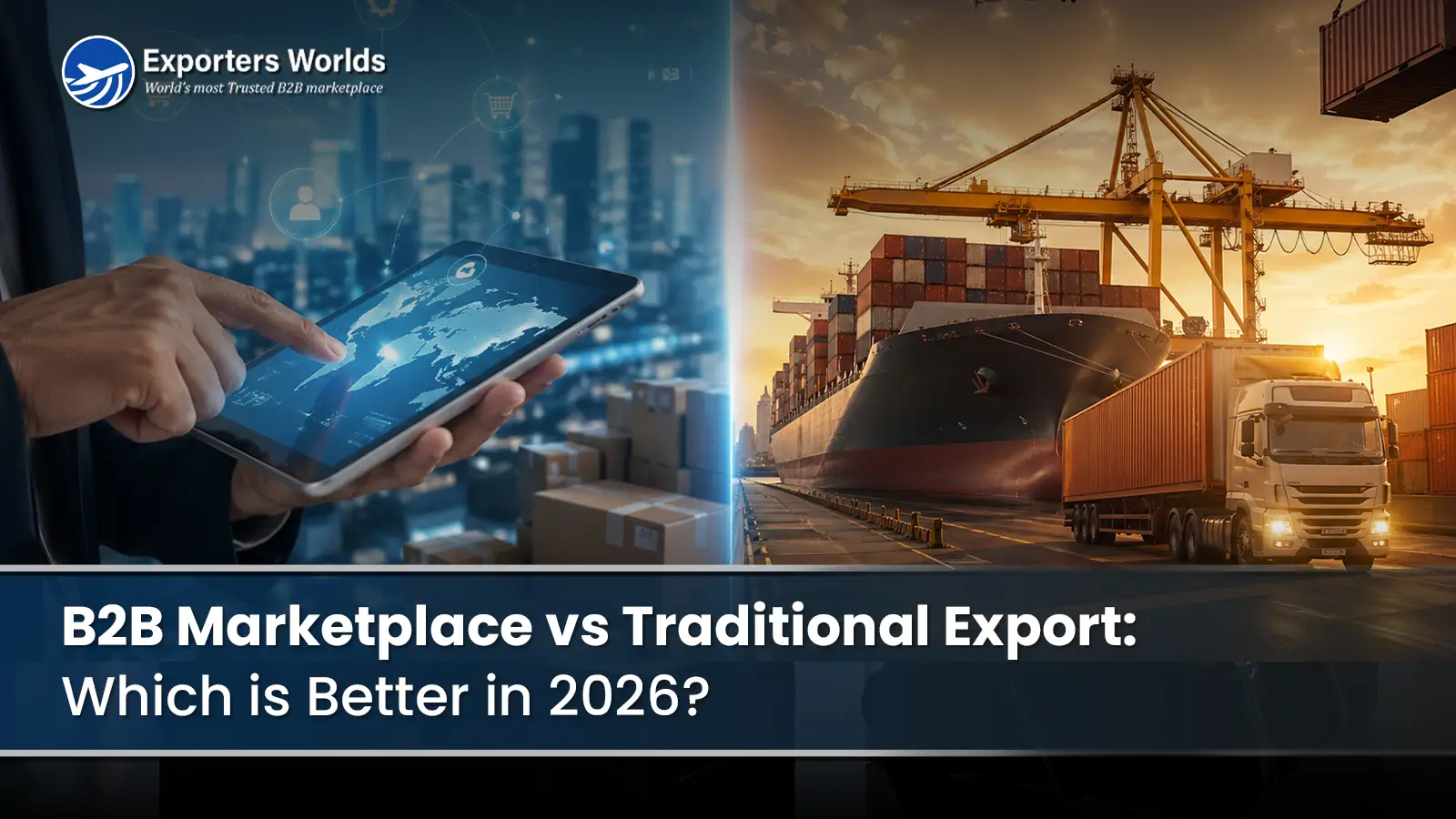
B2B Marketplace vs Traditional Export in 2026: What Actually Works for Global Trade Today?
Introduction: Where Export Strategy Broke (and Rebuilt Itself)
Not long ago, a mid-sized exporter could plan their entire year around trade fairs, distributor meetings, and a handful of overseas trips. That playbook worked. Until it didn’t.
Over the past few years, something shifted. Exporters who once poured budgets into exhibitions started quietly redirecting funds toward online trade platforms. Not because they wanted to experiment, but because they had to. Footfall became unpredictable, buyer expectations changed, and digital discovery started replacing physical presence.
Today, exporters are not choosing between digital and traditional methods. They are navigating both under pressure.
The backdrop makes this even more complex. Global trade crossed $35 trillion in 2025, yet projections for 2026 show growth slowing to around 0.5%. At the same time, rising tariffs, geopolitical fragmentation, and supply chain reshuffling are forcing businesses to rethink how they operate in international trade.
So the real question is not whether one model replaces the other.
It is this: Is the rise of the B2B marketplace redefining export, or simply reshaping how it works?
This article breaks down what is actually happening on the ground. Not theory. Not hype. Just how exporters are balancing cost, speed, trust, and scalability in 2026.
The 2026 Global Trade Reality: Why Export Models Are Shifting
Trade Is Growing—But Getting Complicated
On paper, global trade is still expanding.
- Total trade volume crossed $35 trillion in 2025 with roughly 7% growth
- Forecast for 2026 suggests a slowdown to about 0.5%
- Services trade is growing faster at nearly 9%
- India’s exports reached $860 billion in FY 2025–26, growing 4.22%
So growth is not disappearing. It is becoming harder to capture.
Exporters who once relied on stable routes are now juggling multiple sourcing regions, evolving compliance requirements, and fluctuating demand patterns. The simplicity is gone.
The real challenge is not entering global markets. It is navigating them efficiently.
Digitalization Is No Longer Optional
Around 85% of B2B companies now operate with ecommerce-enabled systems. Procurement is increasingly shifting toward self-service digital environments where buyers expect instant access to suppliers, pricing, and product details.
This is where b2b export strategies are undergoing a silent transformation.
Traditional export did not fail. It simply did not evolve at the same pace as buyer behavior.
Understanding the Two Models: How They Actually Work
What Is a B2B Marketplace (Digital Export Model)?
A b2b marketplace is essentially a digital ecosystem where buyers and sellers connect, negotiate, and transact across borders.
Platforms like Alibaba, Amazon Business, IndiaMART, Global Sources, and emerging players in b2b services have made global trade more accessible than ever.
Core features include:
- Digital product catalogs
- RFQs (Request for Quotations)
- Integrated logistics and export documentation services
- Built-in communication tools
Here’s the real shift: instead of pitching repeatedly to distributors, exporters can list once and attract inquiries continuously.
That alone changes the entire sales dynamic.
What Is Traditional Export (Offline Model)?
Traditional export relies on physical channels and human networks.
This includes:
- Trade fairs and exhibitions
- Agents and distributors
- Direct negotiations
- Long-standing business relationships
It is deeply relationship-driven. Trust is built over time, often face-to-face.
But there is a catch. Entering a new market often feels like starting from zero. New contacts, new negotiations, new risks.
Market Size & Growth: Where the Momentum Clearly Is
B2B Ecommerce Is Outpacing Everything
The numbers here are hard to ignore.
- Global B2B ecommerce market: $32.8 trillion in 2025–26
- Projected to reach $61.9 trillion by 2030
- CAGR: 14.5%
- Around 65% of B2B transactions now happen via marketplaces
- By 2026, 80% of B2B sales interactions are digital
This is not a trend. It is a structural shift in global B2B ecommerce.
Traditional Export Is Growing—But Slower
Traditional export is still expanding, but its growth is tied closely to overall trade performance, typically between 4% and 7%.
It remains dominant in:
- Heavy industrial goods
- Government contracts
- Long-term institutional deals
But compared to marketplaces, the growth pace is significantly slower.
The takeaway is simple: marketplaces are scaling two to three times faster.
Buyer Behavior Has Flipped the Entire Game
What Modern B2B Buyers Expect
Today’s buyers do not want to wait for meetings or trade fairs.
They expect:
- Self-service purchasing options
- Real-time pricing visibility
- Quick responses
- Digital communication channels
This shift in B2B buyer behavior is redefining how deals begin.
Stats That Signal the Shift
- 58% of sellers are active on three or more online trade platforms
- 75% expect marketplace-driven growth in the next three to five years
Traditional export is seller-driven. You decide when and how to approach buyers.
Marketplaces are buyer-driven. Buyers decide when to engage, compare, and negotiate.
And in 2026, buyers control the timeline.
B2B Marketplace vs Traditional Export: Deep Comparative Analysis
Market Access & Reach
Marketplaces provide instant global visibility. You can reach buyers across multiple regions without physically being there.
Traditional export depends heavily on networks and geography.
If visibility is your bottleneck, marketplaces solve it faster than any trade fair ever could.
Cost Structure & ROI
A typical trade exhibition involves travel, booth setup, logistics, and time investment.
In contrast, digital trade platforms offer lower setup costs and scalable spending.
One trade show budget can often fund months of digital lead generation.
That alone changes the economics of international trade.
Trust & Relationship Building
Traditional export excels at building deep, long-term relationships.
Marketplaces approach trust differently. They rely on verification systems, ratings, and transparent communication.
Trust is not missing. It is simply built through different mechanisms.
Speed & Operational Efficiency
Speed is becoming a competitive advantage.
Marketplaces enable:
- Faster lead generation
- Shorter negotiation cycles
- Integrated workflows for trade compliance and logistics
Traditional methods are slower by design. Deals take time, coordination, and multiple touchpoints.
Risk, Compliance & Security
Marketplaces increasingly offer verification layers and compliance support.
Traditional export relies more on intermediaries to manage risk.
Risk has not disappeared. It has just been redistributed across systems.
Brand Visibility vs Control
Marketplaces offer high discoverability through SEO and listings.
Traditional export provides stronger control over brand narrative.
This creates a classic trade-off: reach versus control.
The Rise of Hybrid Models: Where Exporters Are Actually Heading
Why “Either/Or” No Longer Works
In practice, exporters are not choosing one model.
They are combining both.
A typical flow now looks like this:
- Lead generation through digital channels
- Negotiation through a mix of online and offline interactions
- Relationship building through traditional engagement
This hybrid approach is becoming the default export business strategy.
Bridging the Gap
Modern platforms are evolving beyond simple listings.
They combine:
- Marketplace efficiency
- Relationship-driven reliability
- Support for cross-border trade solutions
The shift is subtle but powerful. Export is no longer just about finding buyers. It is about managing the entire journey from discovery to deal closure.
Key Trends Reshaping B2B Export in 2026
Digital Trade Acceleration
AI and automation are transforming procurement processes.
With 85% adoption of ecommerce systems, digital is now the backbone of trade.
Supply Chain Realignment
Businesses are diversifying sourcing regions to reduce dependency on single markets.
This is increasing demand for flexible wholesale marketplace platforms.
Platform Economy Explosion
The number of marketplaces has grown nearly tenfold in the past five years.
Competition is rising, but so is opportunity.
Hybrid Export Models Becoming Default
The most successful exporters are blending:
- Digital discovery
- Offline negotiation
- Long-term relationship building
Limitations You Can’t Ignore (Both Sides Have Them)
B2B Marketplace Challenges
-
High competition can create price pressure
- Dependence on platform algorithms
- Limited personalization in early interactions
Traditional Export Challenges
-
Slower scalability
- High operational costs
- Limited reach
- Strong reliance on intermediaries
No model is perfect. The key is knowing how to use each effectively.
Commercial Readiness: Which Model Fits Your Business?
Best Fit for B2B Marketplaces
-
SMEs entering international market expansion
- Commodity exporters
- Digital-first brands
- Businesses aiming for rapid scale
Best Fit for Traditional Export
-
High-value industrial products
- Government and institutional contracts
- Long-term exclusive partnerships
Choosing the right mix depends on your product, market, and growth goals.
Final Verdict: What Actually Works in 2026
Here is the reality.
B2B marketplaces are the primary growth engine.
Traditional export is the relationship layer.
Export is no longer linear. It is multi-channel.
The smartest exporters are not choosing one over the other. They are combining both to maximize reach, speed, and trust.
Conclusion: The Future of B2B Export Is Blended, Not Binary
If you strip everything down, the equation looks like this:
- Speed comes from b2b marketplace adoption
- Trust is strengthened through traditional export methods
- Scale is achieved through hybrid execution
Export success in 2026 depends on how well you balance digital reach with human relationships.
For businesses trying to navigate this shift, the challenge is not just finding buyers. It is managing visibility, credibility, communication, and compliance in one cohesive system.
This is where platforms like Exporters Worlds quietly stand out.
Instead of forcing businesses to choose between digital efficiency and traditional reliability, it brings both together. From verified buyer networks and direct communication channels to support with documentation, marketing, and deal execution, it addresses the gaps exporters often struggle with across fragmented systems.
The advantage is not just access. It is alignment.
When your b2b export efforts, visibility strategy, and operational support work together, growth becomes far more predictable.
If you are serious about expanding in international trade, it is worth exploring platforms that do more than list your products. Look for ones that actively support your journey from discovery to deal closure.
Because in today’s market, visibility alone is not enough. Execution is everything.
FAQs
What is the difference between a B2B marketplace and traditional export?
A b2b marketplace operates digitally, enabling faster discovery, communication, and scalability. Traditional export relies on offline channels like trade fairs and distributors, focusing more on relationship-building.
Are B2B marketplaces replacing traditional export in 2026?
No. They are dominating early-stage processes like lead generation, but traditional export remains critical for closing deals and building long-term relationships.
Which is more cost-effective for international trade?
Marketplaces generally offer lower customer acquisition and operational costs compared to traditional export methods.
Is trust a concern in online trade platforms?
Modern online trade platforms include verification systems, ratings, and secure communication tools that help reduce risk and build trust.
Can SMEs succeed using B2B marketplaces?
Yes. Marketplaces lower entry barriers and provide global visibility, making them ideal for SMEs entering international trade.
What is the future of B2B export models?
The future lies in hybrid systems that combine digital discovery with traditional relationship management, creating more efficient and scalable export strategies.