How to Find Reliable Wholesale Suppliers for International Business
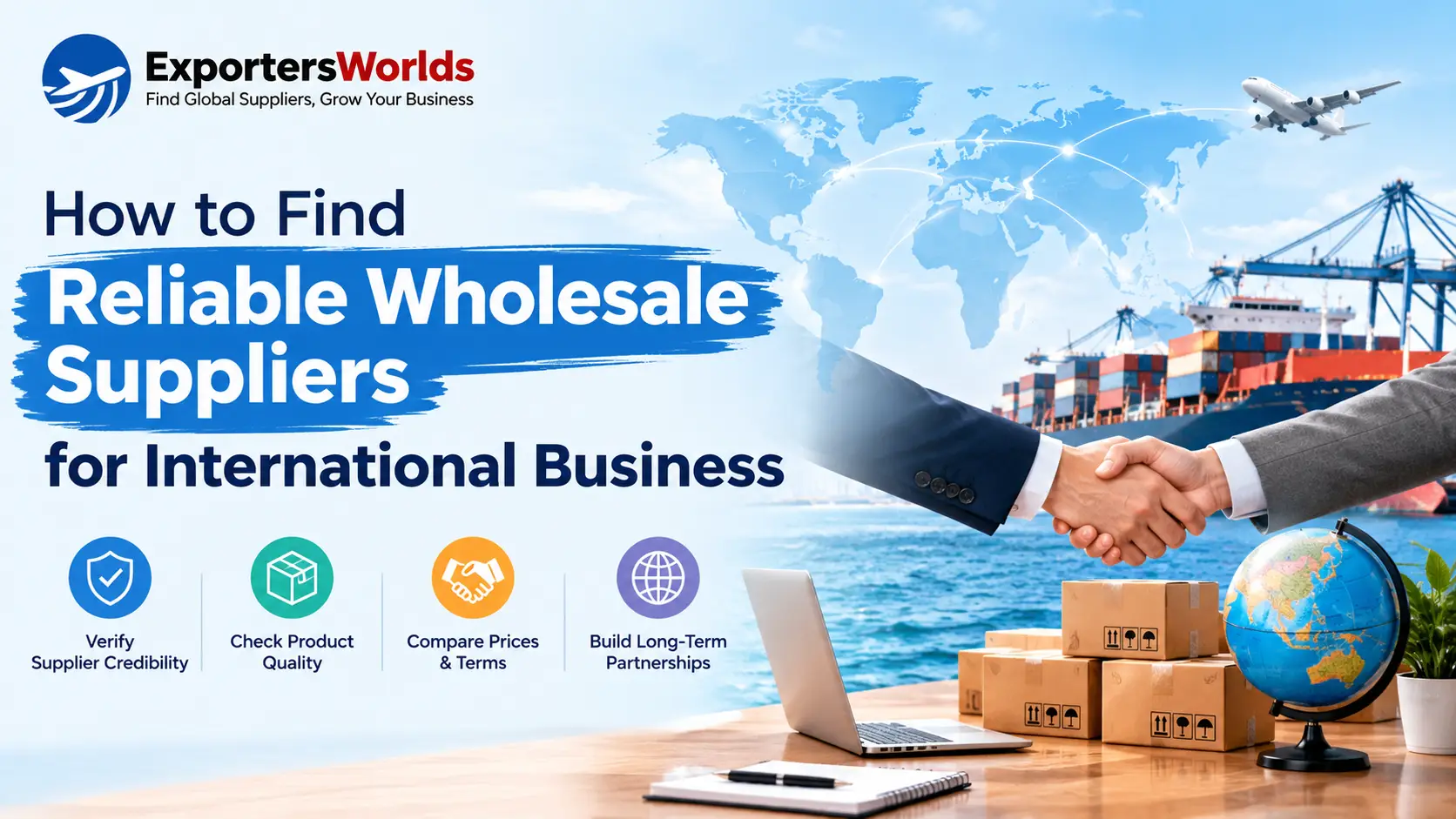
Finding reliable international wholesale suppliers takes more than browsing product listings and comparing prices. U.S. importers, retailers, distributors, e-commerce businesses, and procurement professionals need to verify supplier legitimacy, assess product quality, compare commercial terms, and understand shipping and import requirements before committing to a purchase.
The best approach is to define your sourcing requirements, shortlist relevant wholesale suppliers, request verifiable business information, evaluate samples, and start with an order size that matches your risk tolerance. A supplier's online profile is a starting point, not proof of reliability.
B2B marketplaces, trade directories, industry exhibitions, referrals, and direct manufacturer outreach can help you discover potential partners. Platforms such as Exporters Worlds can also serve as a starting point for exploring suppliers across product categories.
However, a listing or verification label should never replace your own due diligence. The goal is to find an international supplier that can consistently meet your requirements for quality, price, communication, delivery, and compliance.
1. Define Your Wholesale Sourcing Requirements
Before searching for international wholesale suppliers, determine precisely what your business needs. A clear sourcing brief makes it easier to compare suppliers and prevents you from wasting time on unsuitable offers.
Specify your product type, technical specifications, materials, required certifications, packaging, expected order volume, target price, and delivery destination. If appearance or performance matters, document the relevant quality standards.
Also establish your minimum and expected purchasing quantities. Many wholesale suppliers offer lower unit prices for larger orders, but buying in bulk can increase storage expenses, cash-flow pressure, and the risk of unsold inventory.
For example, a U.S. retailer sourcing apparel should clarify fabric composition, sizing, labeling, packaging, and order quantities before requesting quotations.
Practical tip: Prepare a written request for quotation (RFQ) with the product specifications, estimated volume, destination, required delivery window, and questions about payment and shipping. Send the same RFQ to each shortlisted supplier so you can compare offers fairly.
2. Where Can You Find International Wholesale Suppliers?
Several sourcing channels can help you discover potential business partners. Each has different strengths, so using more than one can provide a broader view of the available market.
B2B marketplaces: These platforms allow buyers to explore product listings, supplier profiles, and business enquiries across multiple industries. They can help you compare options without contacting every manufacturer individually. However, listing quality, verification standards, and available supplier information differ between platforms.
Industry trade directories: Trade associations, industry publications, and specialized directories can help identify manufacturers and distributors in particular sectors. Check whether the directory explains how businesses are listed and whether its information is regularly updated.
Trade shows and exhibitions: Industry events offer opportunities to meet suppliers, inspect samples, discuss production capabilities, and assess communication firsthand. Follow up by verifying the business independently rather than relying only on an exhibition conversation.
Referrals and professional networks: Recommendations from established business partners, industry groups, freight forwarders, and sourcing professionals can help uncover suppliers with relevant experience. Treat referrals as leads to investigate, not guarantees.
Direct manufacturer outreach: Contacting manufacturers can be useful when you need product customization, specific technical standards, or greater control over production. Ask whether the company manufactures the product itself or operates as a trading company or intermediary.
A B2B wholesale directory can help build your initial shortlist. For example, buyers can explore product categories and potential supplier connections through Exporters Worlds. As with any sourcing channel, independently assess each prospective supplier before placing an order.
3. Verify Supplier Legitimacy Before Making a Commitment
A professional website, attractive catalogue, or low quotation does not prove that a business is legitimate. Verify the supplier's identity before sharing sensitive information or transferring money.
Start by checking its registered business name, physical address, available registration details, business contact information, and length of operation where records are available. For overseas companies, consult the relevant official business registry or government resources in the supplier's country.
Next, compare the information across its website, quotation, invoice, email domain, and payment instructions. Material inconsistencies deserve further investigation.
Request references from business customers who have purchased comparable products. Ask about product consistency, communication, delivery performance, and how the supplier handled problems.
You can also request a live video meeting from the business premises or production facility. For larger orders, consider an independent factory audit or third-party inspection.
Keep these warning signs in mind:
- Prices substantially below comparable offers without a credible explanation.
- Pressure to pay immediately or accept unusual payment arrangements.
- Refusal to provide basic business documentation or product information.
- Last-minute changes to bank details or the legal entity receiving payment.
- Promises of guaranteed quality or delivery without clear specifications.
No single warning sign proves fraud, but several together justify pausing the transaction. Do not treat a marketplace profile or supplier verification badge as a substitute for independent checks.
4. Evaluate Product Quality Before Ordering in Bulk
A supplier may be legitimate yet still fail to meet your quality expectations. This is why product evaluation should be part of the sourcing process, not an afterthought.
Request samples whenever practical. Compare the sample with your written specifications, including dimensions, materials, finish, performance, packaging, and labeling. For products with technical requirements, ask for relevant test reports or certificates and verify their applicability to the exact product.
For larger or repeat orders, establish written quality acceptance criteria. Depending on the product and risk, you may arrange pre-production approval, in-process inspections, or a pre-shipment inspection by an independent service provider.
Do not assume that a sample guarantees every unit in a production run will be identical. Your purchase agreement should explain what happens if goods fail inspection, arrive damaged, or differ from the approved specification.
For regulated products, check the relevant U.S. requirements before ordering. Depending on the product, agencies such as the U.S. Food and Drug Administration (FDA), Consumer Product Safety Commission (CPSC), or U.S. Department of Agriculture (USDA) may be relevant. Confirm the applicable rules for your specific product rather than assuming the supplier handles every obligation.
5. Compare Wholesale Prices, MOQs, and Payment Terms
The cheapest quotation is not necessarily the least expensive option. Compare the total cost of getting acceptable products to your destination, not only the supplier's unit price.
Ask each supplier about minimum order quantity (MOQ), volume discounts, sample charges, production costs, packaging, tooling, payment milestones, and the validity period of the quotation.
Then estimate the landed cost, which may include product costs, international freight, insurance, customs duties, brokerage, inspection, and domestic transportation. The exact components depend on the product, shipping arrangement, and transaction terms.
Clarify the shipping responsibilities using the agreed delivery terms. International Commercial Terms, commonly known as Incoterms® rules, can help define responsibilities for delivery, costs, and risks. Specify the applicable rule and named place or port in the contract, and ensure both parties understand it.
Payment arrangements also deserve careful attention. Avoid sending funds solely because a seller appears established. Verify the receiving business and bank details through a trusted contact method, particularly when instructions change. For higher-value transactions, consider appropriate safeguards such as staged payments, escrow where suitable, or a letter of credit arranged through a qualified financial institution.
The right supplier offers terms your business can realistically support, not merely an attractive headline price.
6. Check Shipping, Customs, and Delivery Reliability
International wholesale involves more than manufacturing and dispatch. U.S. buyers must account for transportation times, customs clearance, documentation, product restrictions, and possible delays.
Before purchasing, ask the supplier about production lead time, shipping options, packaging, shipment tracking, and the documents it will provide. Clarify who arranges freight, who carries particular costs and risks, and who is responsible for relevant import formalities.
Determine the correct product classification and check applicable duties, restrictions, and documentation requirements using official U.S. government resources, including U.S. Customs and Border Protection (CBP). Requirements vary by product and country of origin. Some goods require additional permits, labeling, testing, or agency review.
For new suppliers, request realistic delivery estimates and a clear process for handling late shipments or damaged goods. Build contingency time into your inventory planning rather than assuming that the quoted date is guaranteed.
7. Build a Long-Term Supplier Relationship
Reliable international wholesale suppliers do more than fulfill one order. They communicate clearly, document commitments, respond to problems, and demonstrate consistency over time.
Keep specifications, approved samples, quotations, invoices, inspection reports, and written agreements organized. Confirm important changes in writing, including pricing, lead times, packaging, and payment instructions.
After the first shipment, review whether the product matched the agreed standard, arrived on schedule, and justified its total cost. Use that evaluation to determine whether to place a repeat order or increase purchasing volume.
Start with a manageable order when commercially practical, and expand the relationship as evidence of performance accumulates. This approach gives both parties a chance to establish workable processes before committing to larger quantities.
Remember that supplier reliability is an ongoing assessment. A business that performed well once still needs to demonstrate consistency across future orders.
How Exporters Worlds Can Support Your Supplier Search
Finding and evaluating wholesale suppliers can be time-consuming, especially when you are comparing businesses across countries, products, and industries. A B2B marketplace can make discovery more organized by bringing product listings and potential business connections together.
Exporters Worlds provides a marketplace for exploring suppliers across categories such as apparel, agriculture, textiles, electronics, machinery, beauty products, and other industries. Buyers can use the platform to discover potential B2B wholesale suppliers and identify businesses that may fit their purchasing requirements.
The platform describes its approach as emphasizing verified business connections, buyer-supplier communication, and sourcing support. These features can help buyers begin their search, but you should still independently check each supplier's credentials, samples, contractual terms, and relevant compliance requirements.
Ready to explore potential suppliers? Visit Exporters Worlds to browse available product categories and supplier opportunities. Start with a clear sourcing brief, explain your purchasing requirements, and evaluate prospective partners against the checks outlined in this guide.
The objective is not simply to find a supplier. It is to establish a commercially viable relationship with a business that can meet your quality, pricing, communication, and delivery expectations.
Frequently Asked Questions
1. Where can U.S. businesses find reliable international wholesale suppliers?
U.S. businesses can search B2B marketplaces, industry directories, trade exhibitions, professional networks, and manufacturer websites. Compare several sourcing channels, then independently verify shortlisted suppliers before making a financial commitment.
2. How do I verify whether an international wholesale supplier is legitimate?
Check official business registration information where available, confirm the physical address and business identity, compare documents and payment details, request relevant references, and arrange a video meeting or independent inspection when appropriate. No single check guarantees reliability.
3. What should I ask a wholesale supplier before placing an order?
Ask about product specifications, samples, minimum order quantities, production capacity, pricing, quality controls, payment terms, lead times, shipping responsibilities, documentation, and procedures for defects or delays. Request written answers and include important commitments in the purchase agreement.
4. How can I compare international wholesale suppliers fairly?
Send the same product specifications and purchasing requirements to each candidate. Compare quality, total landed cost, MOQ, communication, production lead time, delivery terms, payment risk, and documented performance rather than choosing solely by unit price.
5. What is the minimum order quantity in wholesale sourcing?
Minimum order quantity (MOQ) is the smallest quantity a supplier is willing to sell under specified terms. It varies by product, manufacturer, customization, and production setup. Ask whether a sample order, trial quantity, or different price tier is available.
6. How can I reduce the risk of fraud when buying internationally?
Verify the supplier's identity independently, inspect samples, use a written contract, confirm bank details through a trusted channel, and choose payment protections suited to the transaction. Be especially cautious about urgent payment demands, unexplained price differences, and last-minute changes to payment instructions.
7. Can Exporters Worlds help me find B2B wholesale suppliers?
Exporters Worlds offers a B2B marketplace where buyers can explore product categories and potential supplier connections. You can use it as a starting point for supplier discovery, then verify each candidate's credentials, quality, pricing, delivery capabilities, and suitability for your business.