Top Auto Parts Exported from India: Most In-Demand Automotive Components Driving Global Trade in 2026
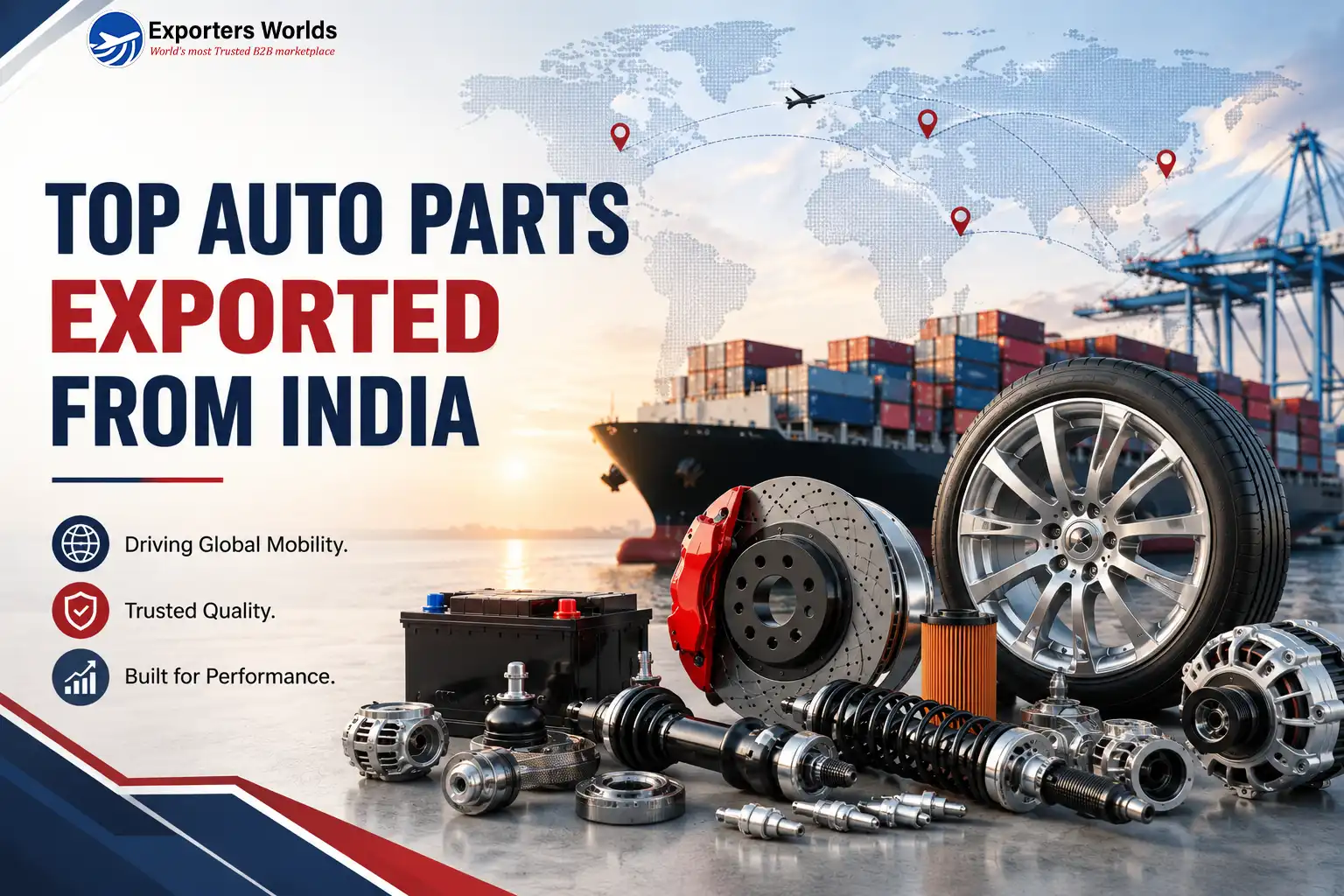
The First Time I Explored India’s Auto Parts Export Industry, I Realized It Was Never Just About Spare Parts
When people think about India’s automotive exports, they often picture complete cars, motorcycles, and commercial vehicles. I thought the same until I looked deeper into how the global automotive supply chain actually works.
A modern vehicle contains thousands of parts, and many of them are manufactured in different countries before final assembly. That means a car built in Germany, the United States, Japan, or Mexico may still contain several automotive vehicle parts produced in India.
India is supplying critical components that influence safety, performance, durability, fuel efficiency, and maintenance.
India’s auto component exports reached about US$22.9 billion during FY2024-25, with nearly 8% year-on-year growth. Indian manufacturers now export to more than 170 countries, while the sector’s export potential is projected to reach US$70 billion to US$100 billion by FY2030.
Why India Has Become a Trusted Exporter of Automotive Vehicle Parts
India’s automotive manufacturing ecosystem has evolved through decades of collaboration among OEMs, Tier-1 suppliers, Tier-2 manufacturers, forging units, foundries, and precision-engineering companies.
International buyers choose Indian suppliers for more than price. They gain access to engineering expertise, scalable production, strong machining capabilities, advanced casting and forging, automation, and experience with global quality standards.
A cheaper part that causes repeated rejection, delayed assembly, or warranty claims can become far more expensive. Consistent production, technical responsiveness, quality documentation, and delivery reliability now carry greater weight in supplier selection.
Where Indian Auto Parts Are Exported Most
The United States remains one of India’s largest auto component export destinations. Other major markets include Germany, the United Kingdom, France, Italy, Brazil, Mexico, Turkey, the UAE, South Africa, Japan, Indonesia, and Thailand.
North America usually demands premium OEM-quality and aftermarket products. Europe places greater emphasis on certifications, precision, sustainability, and documentation. ASEAN markets increasingly source manufacturing components, while Africa and Latin America create strong demand for durable replacement parts.
Top Auto Parts Exported from India
Engine Components
Engine Components remain among India’s most important automotive exports. Major products include pistons, cylinder heads, camshafts, connecting rods, crankshafts, bearings, gaskets, valves, cylinder liners, and timing gears.
These components are used in passenger vehicles, commercial trucks, tractors, marine engines, and industrial machinery. Demand remains high because internal combustion engines still dominate many markets and require regular maintenance, rebuilding, and replacement parts.
Transmission and Drivetrain Parts
India exports gearboxes, gear sets, transmission shafts, clutch assemblies, flywheels, axles, universal joints, propeller shafts, and differential assemblies.
These parts transfer power from the engine or motor to the wheels. Even minor dimensional errors can create vibration, heat, excessive wear, or drivetrain failure, making precision machining essential.
Suspension Parts
Indian suspension parts include shock absorbers, coil springs, leaf springs, ball joints, control arms, stabiliser bars, bushes, and tie rod ends.
They directly affect ride comfort, handling, load stability, and road safety. Demand is particularly strong in commercial vehicles, utility vehicles, heavy equipment, and the replacement market.
Brake System Components
India is a major supplier of Brake System Components, including brake pads, discs, shoes, calipers, drums, hoses, master cylinders, and wheel cylinders.
These products remain in high demand because they are safety-critical and have frequent replacement cycles. Stricter safety regulations and growing premium braking technologies are also increasing the need for reliable materials and traceable production.
Filters
Filters are among the strongest aftermarket export categories. India supplies air filters, oil filters, fuel filters, cabin filters, and hydraulic filters.
Vehicle growth, preventive maintenance, regular replacement cycles, and stricter emission standards continue to support this category.
Steering, Electrical, and Electronic Components
Steering racks, gears, columns, knuckles, and power-steering pumps require high precision because they directly influence control and safety.
India is also expanding rapidly in wiring harnesses, starter motors, alternators, spark plugs, ignition coils, sensors, relays, switches, and electronic control units. Vehicle electrification and smart mobility are making automotive electronics one of the fastest-growing export segments.
Wheels, Rubber, Fasteners, and Cooling Parts
Indian manufacturers export alloy wheels, steel wheels, wheel hubs, bearings, rims, rubber bushes, oil seals, O-rings, engine mounts, hoses, and weather strips.
Fasteners such as bolts, nuts, screws, rivets, washers, and studs may be small, but they carry major export value because every vehicle requires them in large quantities.
Cooling-system products include radiators, water pumps, fans, thermostats, expansion tanks, and intercoolers.
Forged, Cast, Exhaust, and Interior Components
India has a strong reputation in forged crankshafts, gears, steering parts, connecting rods, and axles. It also exports engine blocks, gearbox housings, brake drums, flywheels, and casings.
Exhaust products include manifolds, mufflers, silencers, pipes, and catalytic-converter components. Tightening emission rules are supporting demand for these products.
Mirrors, door handles, dashboards, seat structures, plastic trims, and window regulators are also creating new opportunities for Indian suppliers.
Which Components Have the Highest Global Demand?
Very high-demand categories include Engine Components, Brake System Components, and Filters because of safety needs, frequent replacement, and large global vehicle populations.
Transmission parts, electrical products, suspension parts, forgings, and fasteners remain in high demand because they support both new vehicle production and aftermarket maintenance.
Steering and cooling components fall into the medium-to-high demand range, especially in commercial vehicles, industrial machinery, and heavy-duty applications.
Who Buys These Components?
India supplies passenger vehicle OEMs, commercial vehicle manufacturers, two-wheeler companies, agricultural machinery producers, construction and mining equipment makers, marine companies, industrial engine manufacturers, and aftermarket distributors.
The same supplier may serve multiple industries. For example, a company producing bearings or seals may supply truck manufacturers, tractor companies, marine businesses, and industrial equipment producers.
Certifications International Buyers Expect
Buyers commonly look for IATF 16949, ISO 9001, ISO 14001, and ISO 45001. Depending on the product and market, RoHS, REACH, PPAP documentation, and CE certification may also apply.
These certifications indicate that a manufacturer follows structured systems for quality, safety, environmental responsibility, traceability, and process control.
Key Export Trends in 2025-2026
EV growth is increasing demand for battery casings, motor housings, thermal-management systems, and high-voltage connectors.
Lightweight engineering is supporting exports of aluminium castings, precision forgings, composites, and high-strength steel parts.
Smart mobility is also accelerating demand for sensors, ECUs, ADAS electronics, and advanced wiring systems.
The global aftermarket remains equally important. Ageing vehicles continue to require servicing, repairs, and replacement parts even when new vehicle sales slow.
Challenges and Emerging Opportunities
Indian exporters continue to face competition from China, Vietnam, and Eastern Europe. Freight volatility, raw-material prices, environmental regulations, quality traceability, and OEM localisation expectations also affect competitiveness.
Future growth opportunities include EV platform parts, intelligent electronic modules, advanced filtration systems, sustainable materials, lightweight structures, premium aftermarket products, precision machining, and high-performance braking technologies.
Manufacturers investing early in testing, automation, product development, and international compliance are likely to build stronger long-term positions.
Key Market Statistics
The US$22.9 billion export value recorded in FY2024-25 shows India’s growing role in global automotive sourcing.
Nearly 8% annual growth reflects steady international demand. Exports to more than 170 countries demonstrate broad market reach, while the projected US$70 billion to US$100 billion opportunity by FY2030 signals substantial future potential.
Expanding trade agreements and wider international market access could strengthen India’s engineering and automotive exports further.
Final Thoughts: India Is Exporting More Than Components
India’s auto component industry combines manufacturing scale, engineering capability, product diversity, certification readiness, EV potential, and strong aftermarket demand.
Successful exporters are no longer competing on price alone. Global buyers increasingly expect quality, traceability, communication, reliability, technical competence, and long-term supply support.
Finding the right supplier, however, requires more than scrolling through product listings. Buyers need verified businesses, clearer communication, export experience, and assistance with documentation and coordination.
This is where Exporters Worlds can play a practical role. As an established Indian B2B marketplace, it connects international buyers with manufacturers and suppliers while supporting business verification, communication, trade assistance, digital visibility, and export coordination.
For businesses sourcing automotive vehicle parts, the platform can make supplier discovery more structured and dependable. The real objective should not be the cheapest short-term purchase, but a long-term sourcing relationship built on quality, consistency, and trust.
Frequently Asked Questions
Which auto parts are exported the most from India?
The leading categories include Engine Components, Brake System Components, Filters, transmission parts, electrical products, suspension parts, forgings, and fasteners.
Why are Indian automotive vehicle parts gaining popularity?
They offer cost efficiency, engineering expertise, scalable production, international certifications, and strong supply-chain reliability.
Which countries import Indian auto parts?
Major destinations include the United States, Germany, the United Kingdom, France, Italy, Brazil, Mexico, the UAE, Japan, South Africa, Indonesia, Thailand, and Turkey.
What certifications should buyers check?
Buyers should evaluate IATF 16949, ISO standards, RoHS, REACH, PPAP documentation, and CE certification where applicable.
How is the EV transition influencing exports?
It is increasing demand for battery casings, motor housings, thermal-management systems, lightweight materials, sensors, and high-voltage connectors.
What should buyers evaluate before selecting a supplier?
They should assess production capacity, engineering capability, export experience, quality systems, traceability, compliance, delivery performance, and after-sales support.