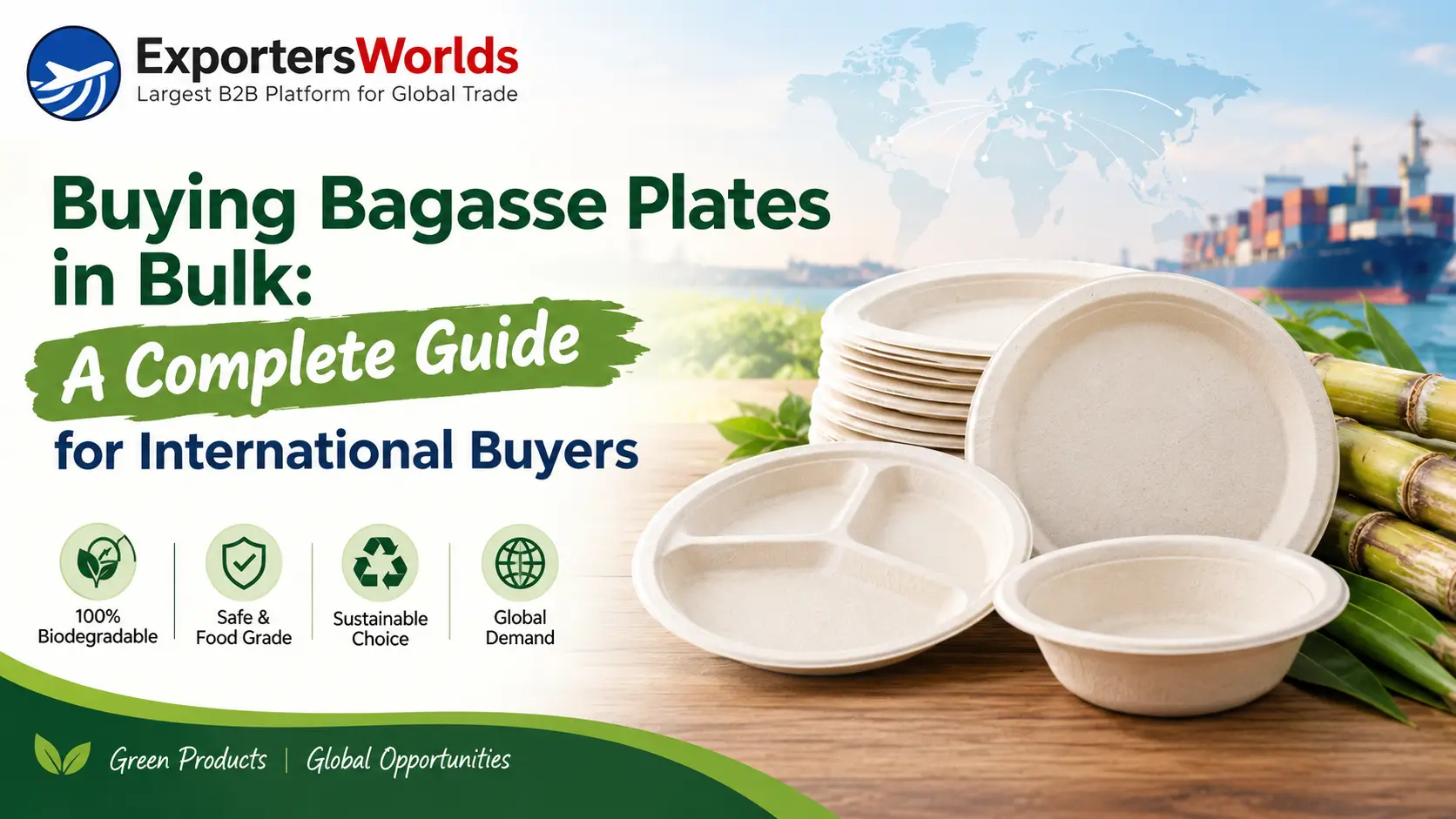
Buying Bagasse Plates in Bulk: A Complete Guide for International Buyers
When a restaurant group, caterer, distributor, or importer starts sourcing compostable plates, the hard part is rarely finding a supplier. The harder part is deciding whether the quoted product will actually perform, arrive on time, meet food-contact requirements, and make financial sense after freight and import costs.
That is why a bagasse plates bulk purchase should be evaluated as a sourcing decision, not simply a price comparison. Bagasse tableware can be a practical alternative to conventional disposable plates, but product quality, MOQ, packaging, customization, and shipping can vary significantly between suppliers.
What Are Bagasse Plates?
Bagasse is the fibrous residue left after sugarcane is processed for juice or sugar. Manufacturers can process this agricultural fiber into molded foodservice products, including plates, bowls, trays, and takeaway containers.
Bagasse plates are often marketed as compostable plates because they can be designed to break down under appropriate composting conditions. However, “compostable,” “biodegradable,” and “eco-friendly” are not interchangeable claims. Compostability depends on the product formulation, certification or test basis, and composting environment. The U.S. Federal Trade Commission's Green Guides emphasize that environmental claims should be truthful and properly qualified.
For international buyers, that distinction matters. A plate may be made from plant-based fiber and still require specific evidence before it is marketed as compostable in a particular market.
Why Businesses Buy Bagasse Plates in Bulk
The main reason to buy bagasse plates bulk is predictable supply at a commercial price. Restaurants, caterers, foodservice distributors, event companies, retailers, and importers may consume thousands or even millions of units, making case quantities and repeat supply more important than consumer-pack pricing.
Bulk sourcing can also support:
- Consistent product specifications across orders
- Custom packaging or private labeling
- Better control over case packs and carton configuration
- Planned inventory for recurring foodservice demand
- Direct communication with manufacturers or export suppliers
Still, the lowest unit quotation is not automatically the lowest-cost option. A better comparison uses landed cost, which can include product price, packaging, inland transport, freight, insurance where applicable, duties or taxes, customs-related charges, and destination handling.
What to Check Before Buying Bagasse Plates Wholesale
Start with the product specification, not the supplier's headline price. Confirm the plate diameter, shape, compartment design, thickness, weight, case pack, carton dimensions, and intended use.
Performance is equally important. Ask whether the product is designed for hot food, oily or greasy foods, refrigeration, freezing, or microwave use. Terms such as “heavy-duty,” “leak-resistant,” and “microwave-safe” should be supported by the supplier's specifications or test documentation. There is no single performance specification that makes every bagasse plate suitable for every application.
For a bagasse plates wholesale order, request representative samples before committing to a large purchase. Check:
- Rigidity with a full portion
- Resistance to oil and moisture
- Heat performance with typical foods
- Molding consistency and surface finish
- Odor or unusual material smell
- Packaging strength during handling
If your business needs custom bagasse plates, private labeling, or bagasse plates with a logo, confirm artwork requirements, tooling or mold charges, print method, minimum quantities, and approval stages early.
MOQ, Pricing, and Lead Time
MOQ, or minimum order quantity, may apply per product, size, color, design, carton, or customized version. A supplier offering a low MOQ for standard plates may require a much larger quantity for custom production.
Make suppliers comparable by specifying the exact product, quantity, destination, packaging, customization, and preferred commercial terms in the RFQ.
Also ask:
- What is the price per plate and per case?
- How many plates are packed in each case?
- Is the quotation based on EXW, FOB, CIF, or another Incoterm?
- What is the production lead time after order confirmation?
- How long is the quotation valid?
- Are samples free, paid, or credited against the final order?
For a bagasse plates bulk order, these details prevent a common mistake: comparing a factory-gate price from one supplier with a delivered price from another.
Choosing a Reliable Bagasse Plate Supplier
A reliable supplier should be able to explain its product clearly and provide consistent documentation. Whether you buy from a manufacturer, exporter, wholesaler, or distributor, look for evidence of operational capability rather than polished marketing alone.
Ask for the company's legal business details, product specifications, food-contact documentation relevant to your market, quality-control process, production capacity, and export experience. Depending on the product and destination, buyers may also request applicable test reports or certifications supporting material, food-contact, or compostability claims.
Supplier verification should also cover communication and accountability. Who handles quality questions? Who confirms artwork? Who updates production status? What happens if cartons arrive damaged or the goods do not match the approved sample?
International buyers should pay particular attention to food-contact compliance. In the United States, food-contact materials can be subject to FDA requirements depending on the substance and intended use. Suppliers should identify the basis for their compliance claims, while buyers should verify that documentation covers the exact finished product and intended conditions of use. For imports, confirm current customs, labeling, and other applicable requirements with the relevant U.S. agencies and your customs professional.
The Bulk Ordering Process
A straightforward sourcing process reduces avoidable surprises:
- Define your specifications and monthly or annual volume.
- Send a detailed RFQ to several qualified suppliers.
- Request samples and supporting documentation.
- Compare quality, MOQ, unit price, case pack, lead time, and landed-cost assumptions.
- Confirm packaging, labeling, and customization details.
- Agree on Incoterms and payment terms.
- Approve the final specification and purchase order.
- Monitor production and arrange inspection when appropriate.
- Review shipping documents before dispatch and track the shipment through delivery.
For larger bagasse tableware purchases, a pre-shipment inspection can be worthwhile when specifications are strict or the supplier is new.
Common Mistakes International Buyers Should Avoid
Do not choose a supplier solely because its bagasse plates wholesale price is lower. Small differences in unit price can disappear once freight, damaged cartons, low pack efficiency, or inconsistent quality enter the calculation.
Do not skip samples. A product can look excellent in photographs and still bend under heavy food, absorb grease, or arrive in weak packaging.
Do not assume every supplier's “compostable” claim has the same meaning. Ask what standard, certification, test method, or disposal condition supports the claim.
And do not leave shipping until the end. Carton size, case quantity, pallet configuration, port, destination, Incoterm, and freight mode can materially affect your final cost.
Where Exporters Worlds Fits
Once specifications are clear, the next challenge is finding suppliers worth contacting. Exporters Worlds is positioned as a B2B marketplace where buyers can discover suppliers and submit sourcing requirements across product categories. Its model combines marketplace listings with supplier-buyer communication and trade-support services.
For a buyer looking for bagasse plates bulk, the useful part is not simply having another supplier directory. A sourcing platform can be more valuable when it helps organize supplier discovery, qualification, quotations, and follow-up.
A practical next step is to prepare one clear buying requirement covering plate size, shape, quantity, packaging, destination, customization, and required documentation. That gives prospective suppliers enough information to respond meaningfully and gives you a better basis for comparison.
FAQs About Bagasse Plates Bulk Buying
Are bagasse plates compostable?
Many bagasse plates are designed and marketed as compostable, but the claim should be checked against the exact product, applicable certification or testing, and the composting conditions available to the end user.
Are bagasse plates food safe?
A bagasse plate is not automatically compliant simply because it is plant-based. Buyers should obtain product-specific food-contact documentation and confirm that it covers the intended food types, temperatures, and market requirements.
Can bagasse plates hold hot or greasy food?
Many products are designed for hot and greasy foods, but performance varies by construction and manufacturer. Ask for the supplier's specifications and test samples with the foods you actually serve.
Are bagasse plates microwave safe?
Some are, but this should be confirmed for the exact product. “Bagasse” alone is not a microwave-safety specification.
What MOQ should I expect for bagasse plates wholesale?
There is no universal MOQ. Standard products may have one MOQ, while custom sizes, molds, printing, and private labeling can require higher quantities. Ask suppliers to state MOQ per SKU and per customization.
How do I compare bagasse plates bulk suppliers?
Compare more than unit price. Review product performance, documentation, sample quality, MOQ, case pack, lead time, payment terms, Incoterms, shipping assumptions, communication, and the resulting landed cost.
Can I order custom bagasse plates or private-label packaging?
Often, yes. Depending on the supplier, customization may include size, shape, compartments, printing, logo application, and packaging. Confirm tooling, artwork, minimum quantities, and approval requirements before production.