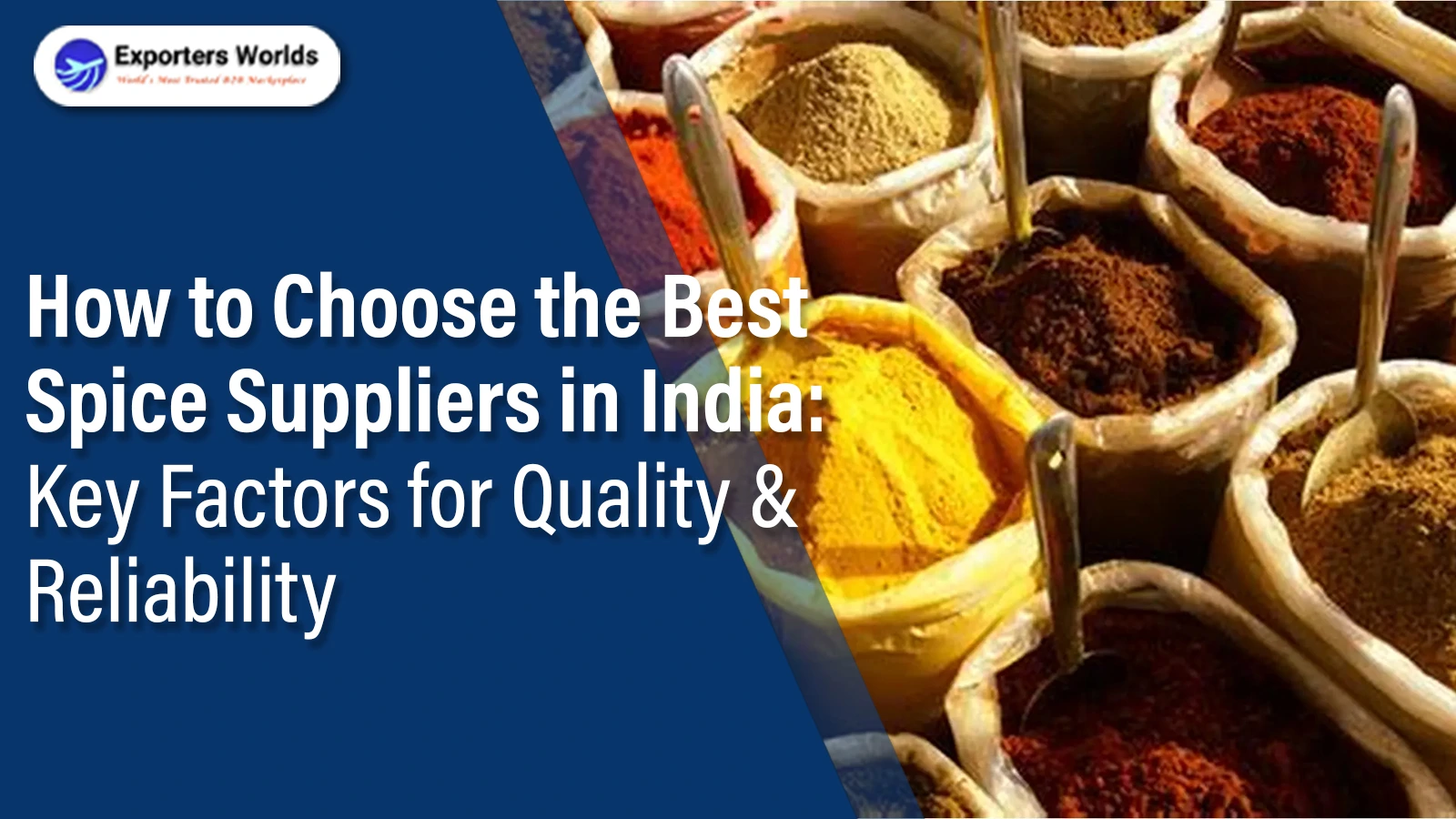
How to Choose the Best Spice Suppliers in India: Key Factors for Quality & Reliability
Introduction
I still remember the first time two batches of the same turmeric behaved differently in production. On paper, both came from the same region, harvested in the same season. But once processed, one released a rich, warm aroma with deep golden color — the other felt dull, flat, and inconsistent. That was the moment it became clear: choosing spice suppliers in India is no longer a routine procurement task. It is a strategic decision that directly affects product quality, brand credibility, and long-term profitability.
Today’s global buyers demand clean-label ingredients, full traceability, and consistent quality across batches. One weak supplier can trigger shipment rejections, regulatory complications, or customer dissatisfaction. The right supplier, however, ensures stable supply, predictable margins, and sustainable business growth.
This article explores how to evaluate spices wholesale suppliers and spice exporters in India using practical decision frameworks, real industry insights, and evolving market dynamics.
The Indian Spice Industry — Market Reality Every Buyer Must Understand
Before choosing a supplier, understanding the structure of India’s spice ecosystem is essential. Buyers who ignore market dynamics often chase the lowest price — and later pay through inconsistency, delays, or quality issues.
Industry Size and Growth Momentum
India remains the world’s largest producer, consumer, and exporter of spices, supplying to more than 150 countries and supporting millions of farmers and small-scale processors.
- Domestic spice market (2025): INR 2,21,832 Crores
- Projected market size (2034): INR 5,28,985.71 Crores
- CAGR (2026–2034): 10.14%
- Spice export volume (2024–25): 17.99 lakh tons (17% YoY growth)
- Export value: Rs. 39,994.48 crore (US$ 4.72 billion — all-time high)
While growth signals opportunity, it also introduces variation in quality, processing standards, and supply reliability across suppliers.
Key Demand Drivers Influencing Supplier Quality
The spice market is evolving rapidly due to:
- Increasing preference for natural, clean-label ingredients
- Rising global interest in functional spices like turmeric and ginger
- Growth of processed foods, nutraceuticals, and spice extracts
- India holding nearly 37% share in global spice exports
- Spice extract market expected to double by 2033
These trends reward suppliers who maintain strict quality and traceability.
Market Pressures Buyers Must Track
- Competitive pressure from China in chilli and cumin markets
- Premium demand for organic and traceable spices
- Global cardamom shortage driving export volatility
- Shift toward customized and value-added spice products
The key takeaway: Quality, traceability, and consistency now define competitiveness.
What Defines a Reliable Spice Supplier in India
Reliability is not a claim — it is demonstrated through operational transparency and consistent performance.
Quality Assurance and Certifications
A dependable supplier maintains verifiable standards such as:
- FSSAI certification
- ISO 9001 quality systems
- HACCP food safety compliance
- Organic certifications (USDA/EU where applicable)
- Routine microbial and adulteration testing
Clear documentation and test reports reduce risk significantly.
Sourcing and Traceability
Reliable suppliers often:
- Source directly from farmers or trusted cooperatives
- Maintain farm-to-export traceability
- Provide region-specific authenticity
- Control moisture, contamination, and purity
Traceability protects both safety and authenticity.
Processing and Hygiene Standards
Key operational indicators include:
- Controlled drying and steam sterilization
- Hygienic processing facilities
- Export-grade packaging
- Consistent aroma, color, and texture
Post-harvest handling often determines final product quality.
Reputation and Operational Experience
Evaluate:
- Years in operation
- Export geography and repeat buyers
- Market reputation and feedback
- Stability during price fluctuations
Reputation reflects discipline and long-term consistency.
Supply Capacity, Pricing, and Logistics
Strong suppliers demonstrate:
- Reliable bulk supply
- Stable pricing structure
- Flexible MOQ
- Export documentation expertise
- Consistent delivery schedules
Logistics reliability directly impacts supply chain stability.
Sustainability and Compliance
Modern buyers expect:
- Ethical sourcing practices
- Controlled pesticide usage
- Environmental responsibility
- Clean-label processing
Sustainability is no longer optional — it is a market expectation.
Step-by-Step — How to Choose the Best Spice Suppliers in India
Selecting the right partner among thousands of spice suppliers in India requires a structured and disciplined approach. Successful buyers don’t rely on assumptions — they validate every stage, from supplier discovery to long-term performance. Below is a deeper look at each critical step in the sourcing process.
Structured Research — Build a Smart Supplier Shortlist
The first step is not contacting suppliers — it is understanding the landscape. India has a vast and fragmented spice ecosystem, ranging from small regional traders to large export-focused processors. Without structured research, buyers often end up comparing incomparable suppliers.
Start by exploring:
- Official export directories (such as Spices Board listings)
- Trade databases showing shipment history and export markets
- Verified B2B platforms with supplier credentials and reviews
- Industry trade fairs and sourcing networks
Shortlist suppliers based on:
- Product specialization (turmeric, chilli, spice extracts, dehydrated products, etc.)
- Export presence and compliance experience
- Processing capabilities and certifications
- Buyer feedback and reliability indicators
A well-researched shortlist reduces risk before the evaluation even begins.
Certification Verification — Confirm Compliance, Don’t Assume It
Certifications are not paperwork — they are proof of quality systems and food safety discipline. Many buyers overlook this step and face regulatory or shipment rejection issues later.
Always verify:
- FSSAI certification for food safety compliance in India
- ISO 9001 for quality management systems
- HACCP for hazard control and hygiene practices
- Organic certification (USDA/EU) if sourcing organic spices
- Country-specific compliance (FDA for the US, EU food safety regulations, etc.)
Request copies of certificates and check validity, scope, and issuing authority. Reliable spice exporters in India will share documentation transparently.
Traceability Assessment — Ensure You Know the True Origin
Traceability has become a non-negotiable requirement in global spice trade. Buyers increasingly demand farm-to-export visibility to ensure authenticity, safety, and compliance.
Evaluate whether the supplier:
- Sources directly from farmers, cooperatives, or verified aggregators
- Maintains batch-level traceability
- Can confirm geographic origin of spices
- Controls moisture and contamination during storage and processing
- Provides documentation supporting traceability
Strong traceability reduces adulteration risk and strengthens regulatory confidence.
Reputation Analysis — Study Real Market Performance
A supplier’s true reliability is reflected in long-term performance, not marketing claims. Reputation often predicts future consistency.
Assess:
- Years of operation and export experience
- Export markets served and repeat client ratio
- Consistency during price volatility or supply disruptions
- Client testimonials, references, and third-party feedback
- Responsiveness and professionalism in communication
Suppliers who survive market cycles usually maintain stronger operational discipline.
Sample Testing — Validate Quality Before Commitment
Even well-documented suppliers must pass practical quality testing. Samples provide real insight into product consistency and processing standards.
Evaluate samples for:
- Aroma strength and natural profile
- Color uniformity and vibrancy
- Moisture level and texture
- Purity and absence of adulterants
- Foreign particle contamination
- Lab test reports (microbial, pesticide residue, heavy metals)
Consistency across multiple sample batches is a strong indicator of supplier reliability.
Negotiation and Logistics — Define the Operational Foundation
Pricing is only one part of a successful sourcing relationship. Logistics clarity prevents delays, disputes, and unexpected costs.
Clarify:
- Pricing structure and fluctuation policy
- Minimum order quantity (MOQ) and scalability
- Packaging standards and labeling compliance
- Payment terms and currency handling
- Delivery timelines and logistics responsibility
- Export documentation and customs compliance
Reliable spices wholesale suppliers will demonstrate transparency and operational clarity during this stage.
Contract and Monitoring — Build Long-Term Supply Stability
Once a supplier is finalized, the relationship must be structured and monitored to maintain consistency over time.
Define in the contract:
- Quality specifications and acceptable tolerances
- Batch consistency requirements
- Delivery schedules and penalties for delays
- Packaging and labeling standards
- Dispute resolution process
After onboarding, continuously monitor:
- Quality consistency across shipments
- Delivery performance and responsiveness
- Pricing stability
- Compliance with agreed standards
Successful sourcing is not a one-time decision — it is an ongoing performance evaluation.
Top 10 Spice Exporters in India — Structure, Specialization, and Operational Philosophy
India’s spice export ecosystem is diverse, with each exporter operating under a distinct philosophy, specialization, and market behavior. Understanding how these companies function helps buyers align with suppliers that match their sourcing strategy, quality expectations, and long-term business goals.
1. The Legacy Guardians
Everest Spices — The Standard-Bearer
Market Identity: Benchmark for consistency and brand trust.
Operational Philosophy: Standardized Blending & Institutional Memory — Everest focuses on eliminating variation, ensuring identical flavor, aroma, and color across batches over decades. Their processes are designed for repeatability rather than cost fluctuation.
2026 Snapshot:
- ~16% share of India’s branded spice segment
- Heavy investment in Cold Grinding Technology to preserve volatile oils and enhance flavor retention
- Strong domestic and export credibility
Everest is preferred by buyers prioritizing predictable quality and process discipline.
MDH Spices — The Heritage Pivot
Market Identity: Symbol of traditional Indian spice authenticity.
Operational Philosophy: Radical Transparency — Following global regulatory challenges, MDH restructured operations around strict compliance, pesticide-residue testing, and ETO-free exports. Their system functions with laboratory-level quality validation.
2026 Snapshot:
- Exports to 60+ countries
- Estimated revenue: $265M–$275M
- Strong trust-driven global presence
MDH blends heritage flavor with measurable compliance, appealing to buyers needing authentic yet regulated products.
2. The Tech & Extraction Giants
Synthite Industries — The Bio-Scientists
Market Identity: World leader in spice extracts and oleoresins.
Operational Philosophy: Chemical Precision & R&D-Centric Operations — Synthite treats spices as functional compounds, delivering defined curcumin, piperine, and active ingredient levels for food, pharma, and fragrance industries.
2026 Snapshot:
- ~30% share of the global spice extract market
- Annual turnover exceeding $350M
- Strong R&D and industrial-scale supply capability
Synthite serves buyers seeking standardized, value-added spice ingredients rather than raw commodities.
Paras Spices — The B2B Architect
Market Identity: Flavor innovation partner for global food brands.
Operational Philosophy: Co-Creation & Custom Flavor Engineering — Paras collaborates with multinational food scientists to develop proprietary seasoning systems tailored to specific product formulations.
Paras is best suited for industrial buyers needing customized spice solutions rather than standard exports.
3. The Logistics & Efficiency Specialists
Nik May Exports LLP — The Agile Integrator
Market Identity: Consolidation and mixed-basket logistics specialist.
Operational Philosophy: Logistical Agility & Shipment Consolidation — Nik May enables buyers to combine multiple agricultural commodities into a single shipment, reducing freight cost and operational complexity.
Their strength lies in coordination, documentation efficiency, and flexible supply management.
JD Enterprises — The Direct-Link Strategist
Market Identity: Farm-to-export supply chain stabilizer.
Operational Philosophy: Disintermediation (Removing Middle Layers) — By connecting directly with farmers and processors, JD maintains price stability, consistent quality, and dependable supply in volatile markets.
Operational Strengths:
- Structured documentation and export compliance
- Strong quality control and packaging discipline
- Reliable logistics and delivery predictability
JD Enterprises is valued for operational consistency and reducing sourcing risks related to delays and quality variation.
4. The Niche & Purity Experts
Citadel Global India — The Dehydration Specialists
Market Identity: Clean-label and moisture-control experts.
Operational Philosophy: Structural Integrity & Precision Dehydration — Citadel preserves the cellular structure, aroma, and purity of dehydrated ingredients without preservatives, ensuring long shelf life and export compliance.
Operational Strengths:
- Advanced dehydration technology
- FSSAI-certified hygienic processing
- Traceable sourcing and moisture control
- Reliable bulk export for food processors and institutional buyers
Citadel focuses on delivering purity, consistency, and clean-label reliability.
MTE Spice — The Sustainability Pioneer
Market Identity: Ethical and traceable spice exporter.
Operational Philosophy: Impact Sourcing & Blockchain Traceability — MTE emphasizes organic cultivation, ethical sourcing, and transparent supply chains, enabling buyers to track origin down to the farm level.
MTE appeals to buyers prioritizing sustainability, traceability, and responsible sourcing.
5. The Volume Powerhouses
VNS Food LLP — The Bulk Reliability Specialist
Market Identity: High-volume consistency provider.
Operational Philosophy: Supply Chain Reliability & Quality Continuity — VNS ensures uniform quality across large shipments, maintaining consistency from first batch to last.
Their strength lies in stable pricing, dependable sourcing networks, and predictable supply.
Shri Sagas Connect Pvt. Ltd. — The Velocity Operator
Market Identity: High-volume, speed-driven exporter.
Operational Philosophy: Volume, Velocity & Delivery Discipline — Shri Sagas focuses on large-scale shipments, standardized packaging, and consistent performance even during peak demand cycles.
Their system prioritizes timely dispatch, documentation accuracy, and supply continuity.
Strategic Insight
Across these exporters, specialization defines value:
- Legacy brands deliver consistency and trust
- Tech-driven firms dominate extraction and precision
- Logistics-focused exporters ensure efficiency and consolidation
- Purity-driven suppliers lead in clean-label and traceability
- Volume players provide large-scale reliability
For buyers, the real challenge is not finding suppliers — it is identifying the right operational philosophy, verifying credibility, and building dependable long-term sourcing partnerships.
Indian Spices Wholesale Pricing — What Influences Cost
Pricing in spice trade is shaped by structural and market-driven factors:
- Seasonal crop output and yield variation
- Global demand and currency fluctuations
- Organic vs conventional sourcing costs
- Processing quality and moisture control
- Packaging, storage, and logistics expenses
- International competition and supply gaps
For example, cardamom prices surged due to global shortages, while organic spices command a 15–40% premium. Turmeric demand continues to rise due to global health trends, and value-added spice formats often deliver higher margins.
Experienced buyers focus on long-term value consistency rather than lowest price.
Emerging Trends Shaping Spice Suppliers in India
- Rising demand for organic and clean-label spices
- Mandatory traceability across global markets
- Rapid growth in spice extracts and customized blends
- Long-term partnerships replacing short-term sourcing
- Technology improving processing precision and shelf life
Future-ready suppliers align with these evolving expectations.
Interesting Facts About the Spice Trade
- India produces over 75 of the world’s recognized spices.
- Turmeric exports have surged due to wellness-driven demand.
- Millions of small farmers depend on the spice ecosystem.
- Black pepper was once used as currency in global trade.
- Value-added spice products often outperform raw spices in profitability.
Common Mistakes Buyers Make
- Prioritizing lowest price over quality
- Ignoring certifications and compliance
- Skipping traceability verification
- Not testing samples before bulk purchase
- Underestimating logistics reliability
- Frequently changing suppliers
Consistency builds supply chain stability.
How the Right Supplier Drives Business Growth
Reliable suppliers enable:
- Consistent product quality
- Lower rejection and compliance risk
- Stable pricing and predictable margins
- Stronger brand credibility
- Reliable supply continuity
- Long-term scalability and growth
Supplier quality often determines business performance.
Conclusion — Choosing Smart, Not Cheap
Selecting the best spice suppliers in India requires more than price comparison. It demands careful evaluation, quality validation, and long-term thinking. Consistency, traceability, and reliability ultimately determine supply chain strength. Businesses that prioritize dependable partners over short-term savings rarely face disruptions, rejections, or unpredictable quality — because stability comes from reliability.
However, finding trustworthy spices wholesale suppliers and credible spice exporters in India is not always straightforward. With thousands of suppliers across regions, verifying certifications, credibility, and consistency can be complex and time-consuming. This is why structured B2B ecosystems are becoming increasingly important — helping businesses discover verified suppliers, compare capabilities, and build transparent long-term partnerships.
In this evolving sourcing environment, platforms like Exporters Worlds naturally support what modern businesses need most — trusted supplier connections, simplified discovery, and reliable trade relationships. By reducing uncertainty and strengthening transparency, such ecosystems help businesses build stable supply chains, consistent quality, and confident global growth.
FAQs
What certifications should a spice supplier in India have?
A reliable supplier should hold FSSAI, ISO 9001, and HACCP certifications to ensure food safety and standardized quality management. For export markets, additional compliance such as USDA/EU organic, FDA, or ETO-free certification may be required depending on the destination country. Verified documentation reduces regulatory risk and strengthens product credibility.
How can I verify spice quality?
Start by requesting representative samples from multiple batches. Conduct sensory evaluation (aroma, color, texture, and flavor), check moisture levels, and review laboratory test reports for purity, microbial limits, and adulteration. Consistent performance across batches is the real indicator of supplier reliability.
Why is traceability important?
Traceability ensures full visibility from farm to export. It helps confirm authentic origin, safety compliance, and contamination control, while also meeting regulatory requirements in international markets. Strong traceability reduces risk and strengthens buyer confidence.
What affects wholesale spice pricing?
Pricing is influenced by crop yield, seasonal variation, export demand, currency movement, organic vs conventional sourcing, processing quality, packaging, and logistics costs. Market disruptions and global supply shortages can also impact price fluctuations.
Are organic spices worth the premium?
Yes. Organic spices often command higher global demand due to clean-label positioning, chemical-free cultivation, and stronger consumer trust. While prices may be higher, they typically offer better long-term market value and brand positioning.
How do I choose between multiple spice exporters in India?
Evaluate suppliers based on certifications, traceability systems, batch consistency, logistics reliability, documentation quality, and market reputation. The most dependable supplier is not the cheapest — but the one that delivers consistent quality and reliable supply over time.